
Menu
tier score = ceiling - volatility + depth (z-scored: raw points, minus how swingy the weekly trio was, plus how many players cleared a real starter's bar in a typical week; median 13+/game, so a couple of boom weeks can't fake depth).

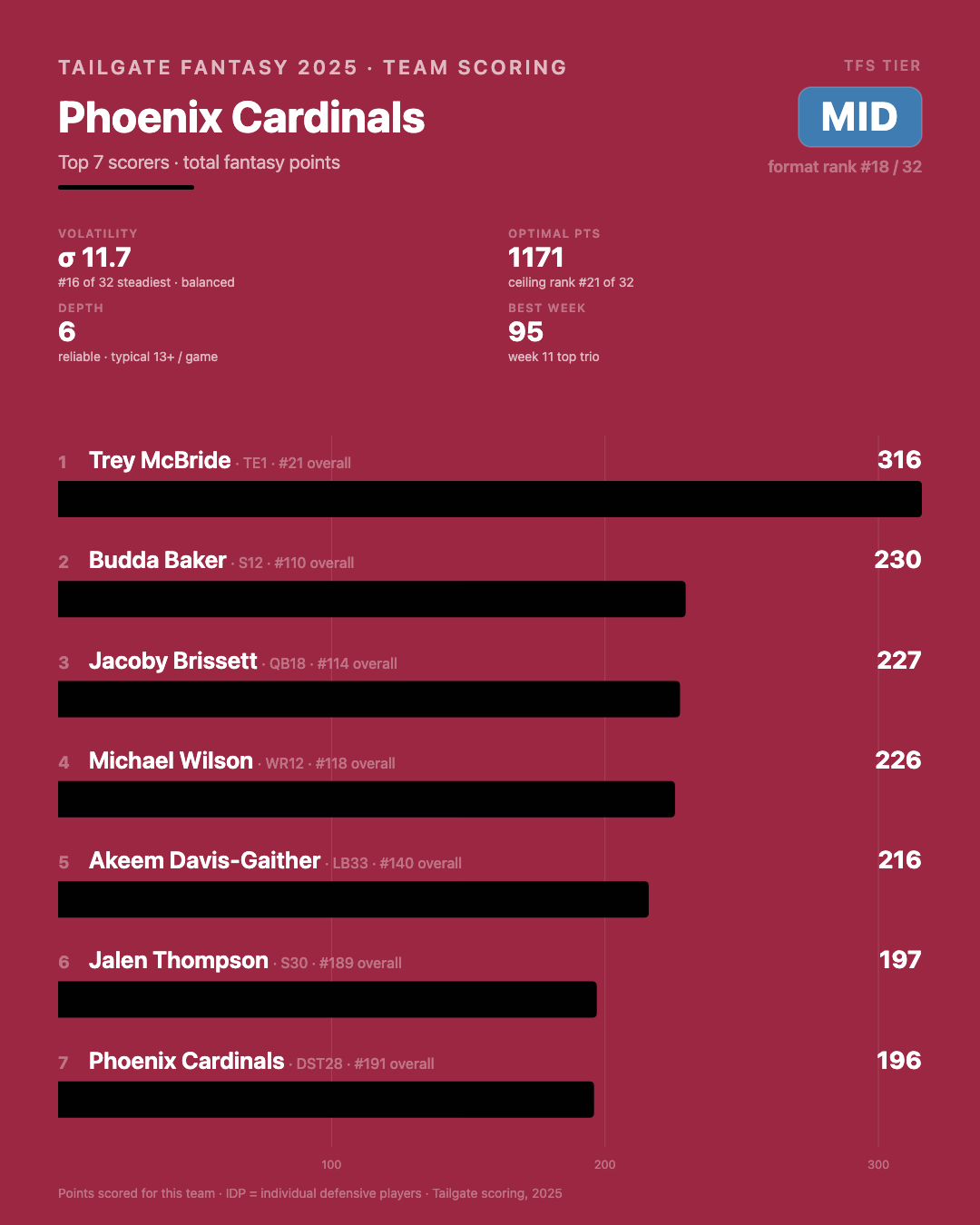
Arizona rostered the single best tight end in football — and it wasn't close.
Trey McBride scored 316 points, TE1 of 131, #21 overall, with 7 boom weeks and zero busts. In a format where the tight end position is mostly a wasteland, having the outright TE1 is a structural advantage: every other team in your league is starting someone who averages single digits there.
1. Trey McBride (TE): 316 · TE1, #21 overall
2. Budda Baker (S): 230 · S12
3. Jacoby Brissett (QB): 227 · QB18
4. Michael Wilson (WR): 226 · WR12
5. Akeem Davis-Gaither (LB): 216 · LB33
The Cardinals were the #21 offense by raw points but climb to #18 in format rank, and the reason is depth: six players cleared a genuine starter's bar in a typical week, and the top five are packed inside 100 points. When the swap rule pulls you off McBride, you land on a top-12 safety or a top-12 receiver, not a scrub. Their best week was 95 points in week 11 — and the trio was a tight end and two receivers, which is a shape almost no other team in this series can produce.The 2026 read is the second half. Michael Wilson averaged 5.5 a game before the break and 20.2 after — the largest in-season swing of any player in this batch, and not a small-sample fluke at 17 games played. Greg Dortch went 11.8 to 21.6. Brissett went 13.5 to 17.8. McBride himself went 16.2 to 20.7.
Nearly the entire offense was pointing up in December. The thing holding Arizona at #18 was never the top of the roster; it was everything under it, and everything under it spent the back half of last season getting better.
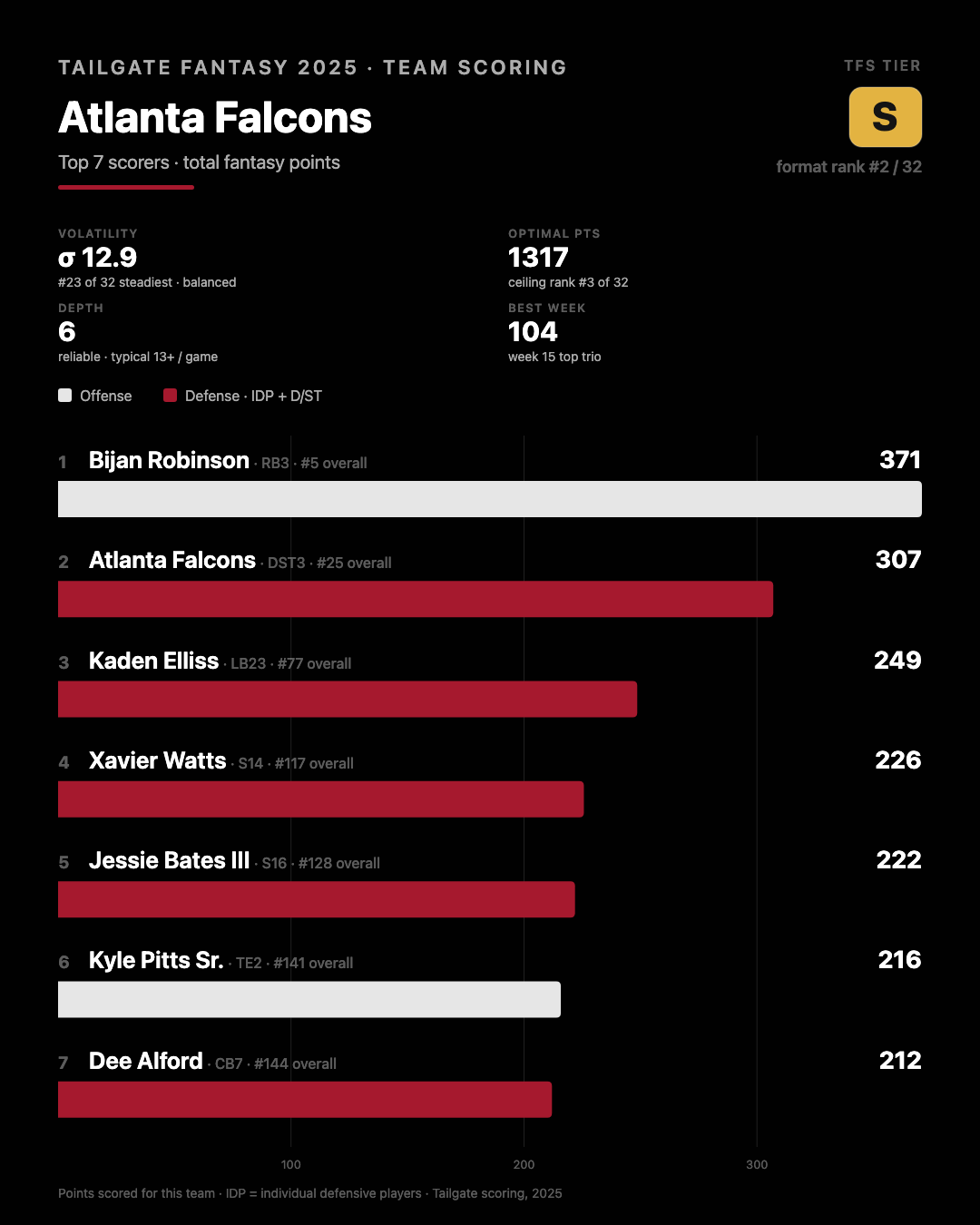
Our first S-tier team of the countdown, and it got there with five defenders in its top seven.
1. Bijan Robinson (RB): 371 · RB3, #5 overall
2. Falcons D/ST: 307 · DST3
3. Kaden Elliss (LB): 249 · LB23
4. Xavier Watts (S): 226 · S14
5. Jessie Bates III (S): 222 · S16
Ceiling #3, format rank #2 of 32 (S tier). Atlanta is the cleanest example on the whole board of what this format actually rewards: a legitimate top-5 overall player, then a wall of 13-a-game defenders behind him so the mandatory weekly swap never costs you anything. Six clear a starter's bar in a typical week, and the D/ST — the #3 defense in football — is the one you rotate in when a matchup looks ugly.
Their best week is my favorite kind of chaos. Week 15: 104 points, and Bijan wasn't the top scorer — Kyle Pitts went for 45.6. Pitts is a fascinating case: TE2 on the season by total points, but one boom week against four busts, so he's the guy you own for the week you can't predict rather than the one you start blind. Even Atlanta's floor was respectable; the worst week of their season was 60.
The 2026 read is broadly positive and almost entirely on the back seven. Jessie Bates went 10.5 to 15.3, Dee Alford 10.9 to 15.6, Divine Deablo 7.7 to 15.7, Pitts 10.9 to 14.3, and Bijan nudged up to 22.2. The one real caution is Drake London, 19.8 a game down to 13.2 across an injury-shortened year — when he played, he was the second-best per-game scorer on this team. Another big question is Tua, can he find the magic again on a new team?
S tier with five defenders in the top seven. Does that change how you'd build an Atlanta roster?
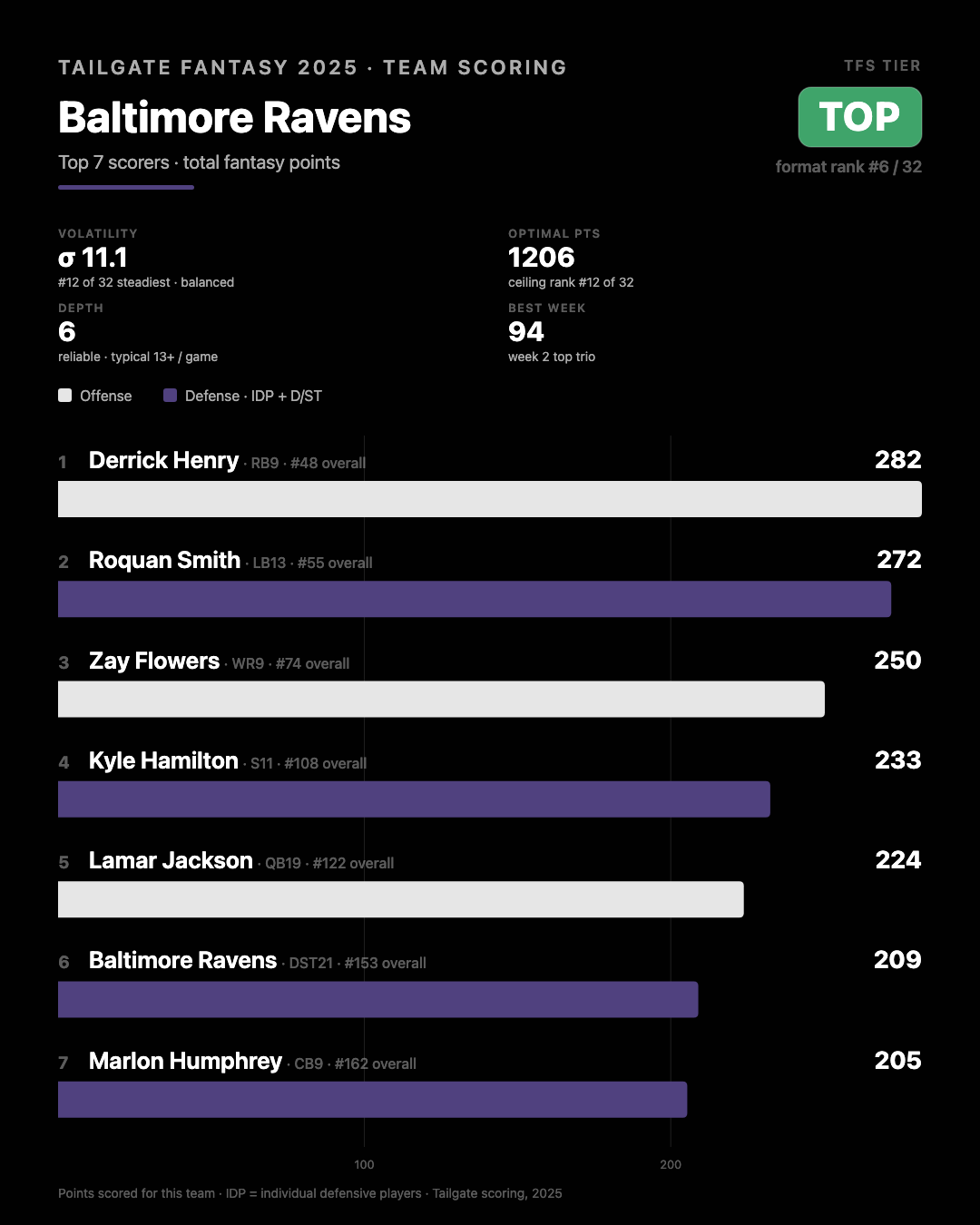
The best argument in this entire series that star power and format value are different things. Baltimore's best fantasy player finished #48 overall. The Ravens finished #6.
1. Derrick Henry (RB): 282 · RB9, #48 overall
2. Roquan Smith (LB): 272 · LB13
3. Zay Flowers (WR): 250 · WR9
4. Kyle Hamilton (S): 233 · S11
5. Lamar Jackson (QB): 224 · QB19
Lamar Jackson was the fifth-best fantasy scorer on his own team, and he still only played 13 games. Derrick Henry led the roster and wasn't a top-45 player in the league. And yet: ceiling #12 climbing to format rank #6, one of the two biggest climbs in the Top tier.
The reason is on the card. Fifty-eight points separate Baltimore's #1 scorer from their #5 — the tightest top five of any Top-tier team in football, and only four rosters in the entire league were tighter, none of them above the middle of the board. Sigma 11.1, six players clearing a starter's bar. When the format makes you bench two of your three starters every week, a flat roster isn't a weakness, it's the whole point: there is no drop-off to swap into. Their best trio week was 94 in week 2 — corner, linebacker, quarterback.
The 2026 split is a straight trade, and I think it favors Baltimore. Derrick Henry went from 13.5 a game to 19.3, the D/ST from 8.6 to 15.6, Marlon Humphrey from 10.6 to 16.4, Zay Flowers 13.7 to 15.6. Going the other way: Roquan Smith fell from 23.4 to 14.6, and Lamar from 24.7 across five early games to 12.6 after. A Ravens team whose back, corner and defense are all trending up, with health-dependent upside still sitting at quarterback and linebacker, is a top-five roster waiting to happen.
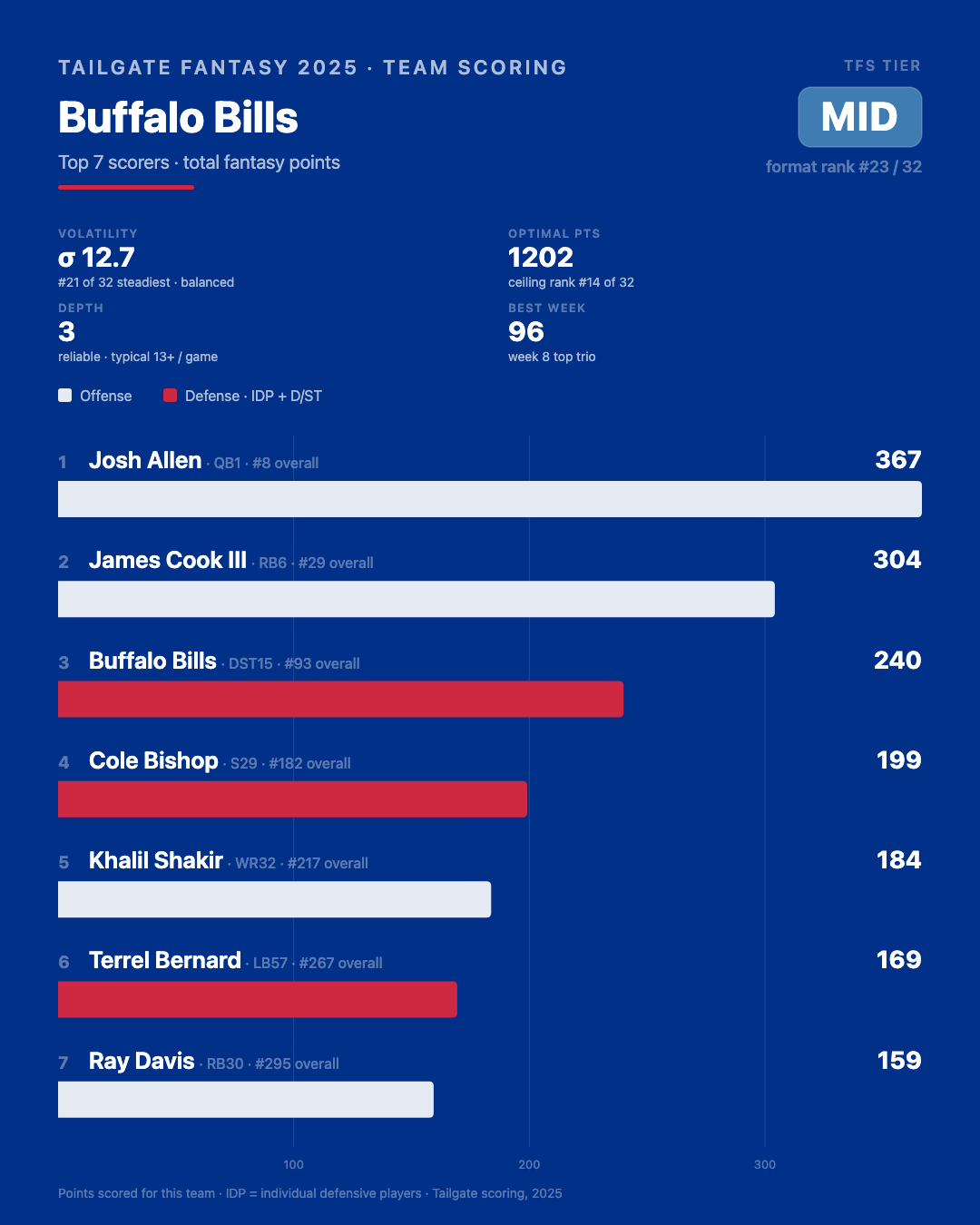
The team that taught us why this whole tier list exists. Josh Allen was the #1 quarterback in football. Buffalo still finished #23.
1. Josh Allen (QB): 367 · QB1, #8 overall
2. James Cook III (RB): 304 · RB6
3. Bills D/ST: 240 · DST15
4. Cole Bishop (S): 199 · S29
5. Khalil Shakir (WR): 184 · WR32
Look at the gap. 183 points separate #1 from #5 — one of the steepest drops on the board — and only three Bills cleared a genuine starter's bar in a typical week. That is the entire problem. The format makes you swap two of your three starters every week, and Buffalo's fourth-best option was a safety averaging 11.7. Ceiling #14, format rank #23 (Mid tier).
Here's what it looked like from the inside. Week 8: 96 points — the D/ST goes for 39, Cook 33.6, Allen 23.2, and you feel unbeatable. Week 11: 94 on Allen's 42.7. Then week 17: 51 points, the lowest week of their season, in the week that actually mattered. I climbed the leaderboard all year on the booms and then got knocked out of the playoffs by someone I'd outscored by 200 points on the season. Ceiling wins seasons; floor wins single weeks.
The 2026 case is quietly about the backfield behind Cook. Ray Davis went from 3.4 a game to 14.7, Ty Johnson 4.9 to 10.1, Christian Benford 9.7 to 11.8 — three swap options that didn't exist in September. Falling hard: the D/ST, 17.6 down to 11.0, Shakir 13.0 to 9.9, Dalton Kincaid 13.2 to 6.8, and Allen himself cooled 23.4 to 19.9. Buffalo doesn't need more ceiling. It needs a fourth and fifth guy, and for the first time it might have them.
Best player in football, #23 roster. Which one would you actually draft around?
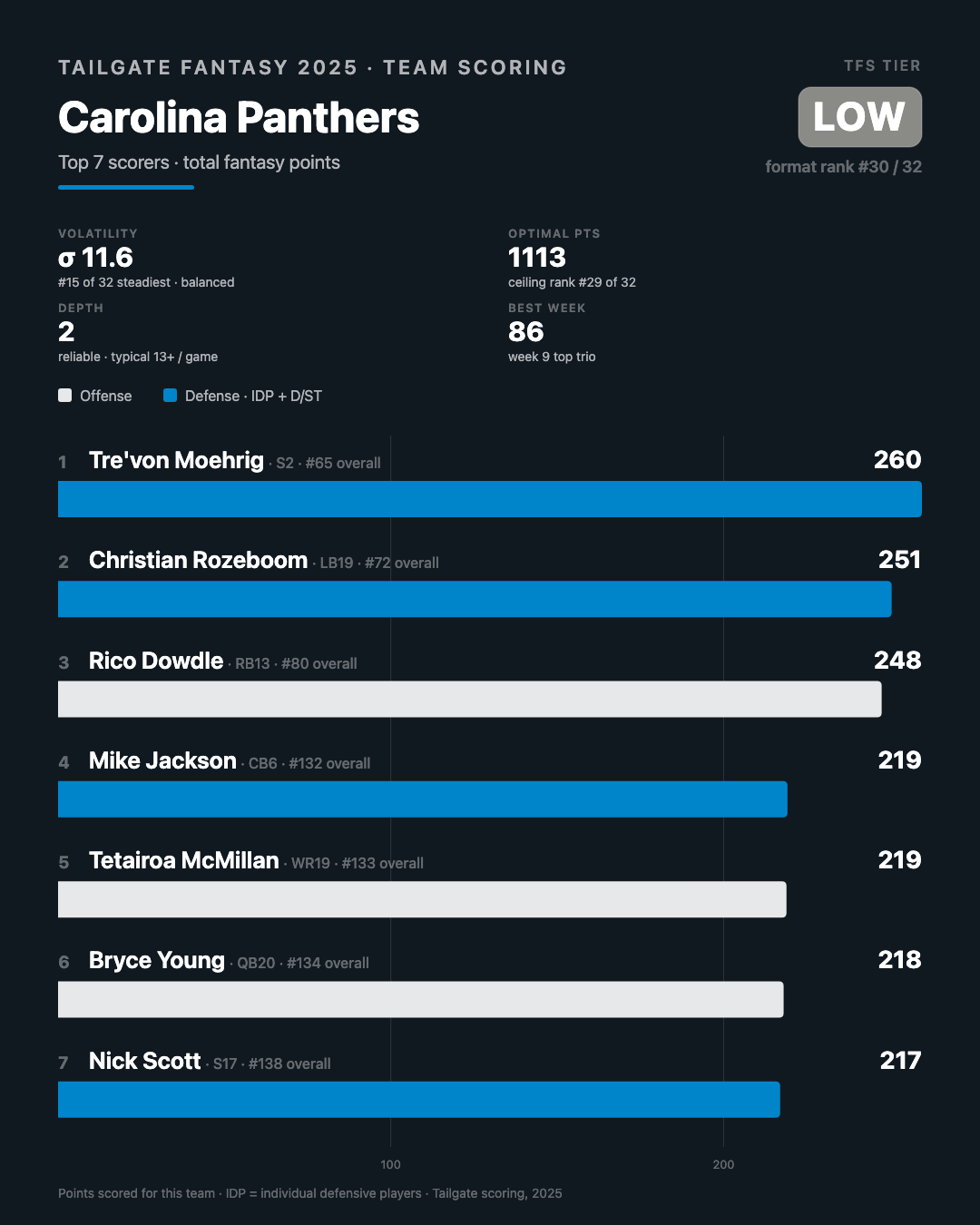
A safety was Carolina's #1 fantasy scorer last year. Bryce Young was 6th.
Carolina was the #29 offense (Low tier), but the internal order is the fun part. Their top two scorers were both defenders:
1. Tre'von Moehrig (S): 260 · #2 safety in the league
2. Christian Rozeboom (LB): 251 · LB19
3. Rico Dowdle (RB): 248 · RB13
4. Mike Jackson (CB): 219 · CB6
5. Tetairoa McMillan (WR, rookie): 219 · WR20
6. Bryce Young (QB): 218 · QB20
The former #1 overall pick was the sixth-best fantasy option on his own team, and a safety and a linebacker both outscored everybody.
That's last season, though, and there's real reason for optimism in Carolina coming into 2026. Young has looked settled under Canales, and he's now throwing to Tetairoa McMillan, a first-round receiver who already cleared WR20 in his rookie year (led all rookie WRs last year). That's how a #29 offense stops being a #29 offense.
Here's the parity angle. Carolina finished near the bottom of the league, but they still rostered the #2 safety in all of football plus a top-6 corner in Mike Jackson (CB6). For traditional fantasy these guys weren't on anybody's radar, and both were league-relevant all season. A Low-tier team is not a dead roster; it's a roster where the value is hiding in guys casual fans have never heard of.
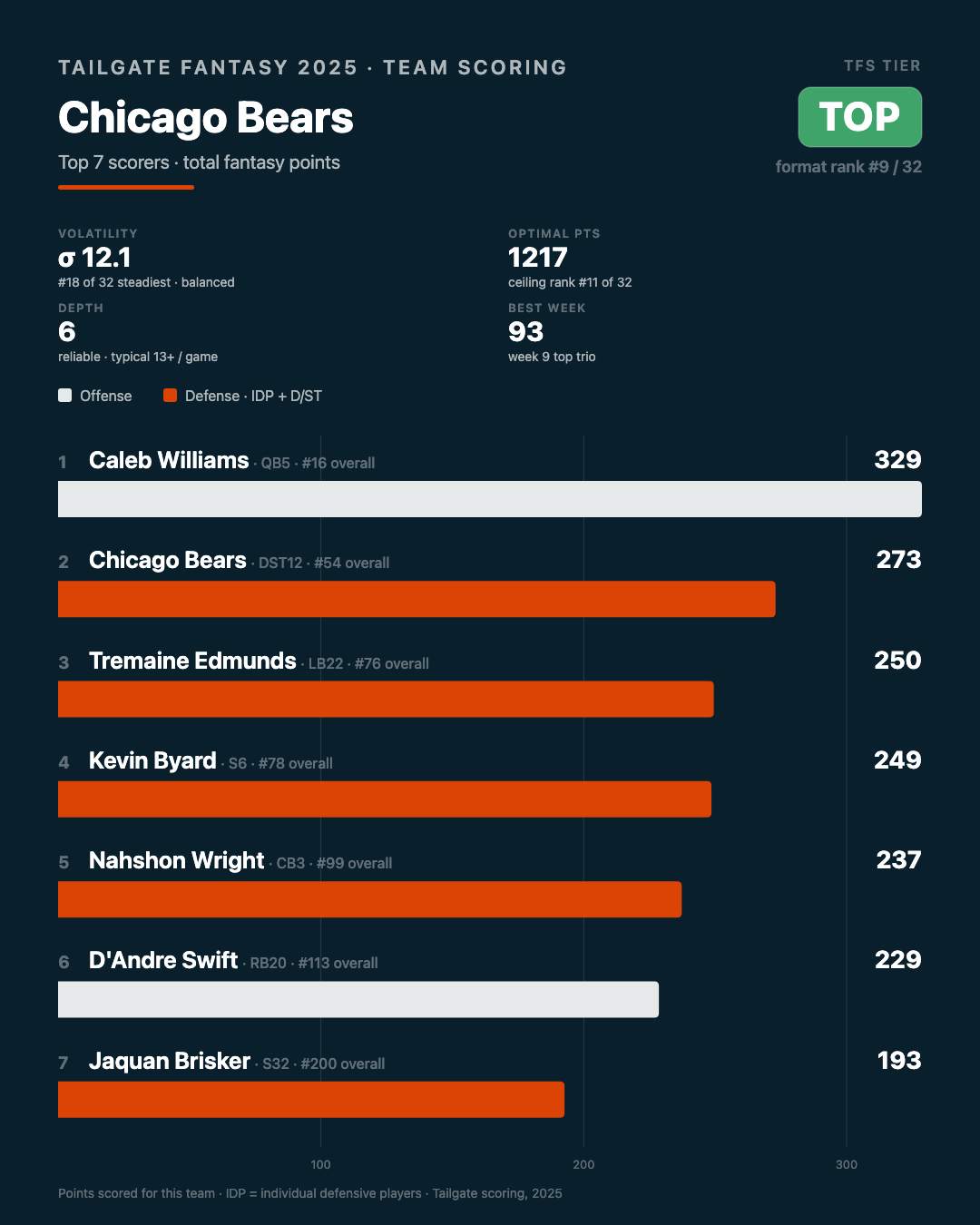
Chicago was the #11 ceiling in football and #9 in format rank — and the fifth name on this list is the one I'd like to talk about.
1. Caleb Williams (QB): 329 · QB5, #16 overall
2. Bears D/ST: 273 · DST12
3. Tremaine Edmunds (LB): 250 · LB22
4. Kevin Byard (S): 249 · S6
5. Nahshon Wright (CB): 237 · CB3
A cornerback was the fifth-highest scorer on a Top-tier roster — CB3 in the entire league. Five of Chicago's top seven were defenders. This is the shape of team that quietly wins leagues in an IDP format: not one enormous week-winner, but six players who all clear the bar, at six different positions, so every forced swap lands on someone useful.
Caleb Williams is the anchor and he was remarkably safe for a young quarterback: 8 boom weeks and zero busts in 17 games. At the other end of the roster, Jaquan Brisker put up a sigma of 4.3 with zero booms and zero busts — the flattest full season on this team and, honestly, exactly what you want in a swap slot. Their best trio week was 92.5 in week 9 (D/ST + quarterback + tight end); their worst was 50.3 two weeks later.
Now the honest part, because every single one of Chicago's top eight scored fewer points per game in the second half than the first. Williams 20.4 down to 18.4, the D/ST 17.4 to 14.9, Edmunds 20.7 to 16.8, Nahshon Wright 16.2 to 11.9, D'Andre Swift 15.9 to 13.0. None of those are collapses on their own, but the direction is unanimous, and it's the one thing that would keep me from ranking Chicago higher than #9 going into 2026.
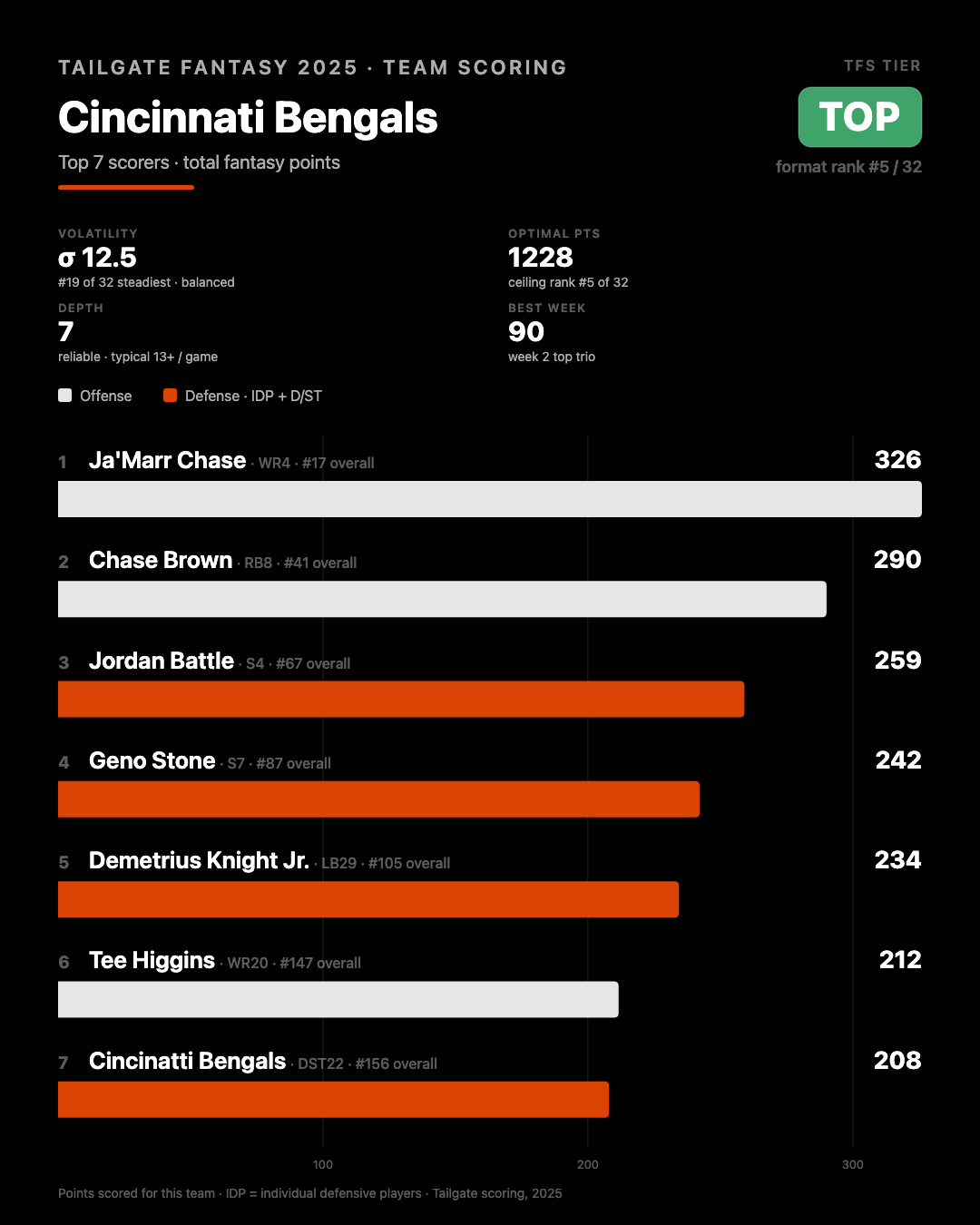
Cincinnati was #5 by raw ceiling and #5 in format rank — one of the very few teams where the scoreboard and the format completely agree.
1. Ja'Marr Chase (WR): 326 · WR4, #17 overall
2. Chase Brown (RB): 290 · RB8
3. Jordan Battle (S): 259 · S4
4. Geno Stone (S): 242 · S7
5. Demetrius Knight Jr. (LB): 234 · LB29
Two safeties in the top four, both of them top-seven at the position, plus a WR4 and an RB8. That's four different shapes inside the top five, and it's why the Bengals hold their ranking instead of sliding: seven players cleared a starter's bar in a typical week, tied third-most in the league. Ja'Marr Chase is the headline — 8 booms against a single bust — but Cincinnati never needed him to carry a week alone.
The volatility is real though. Week 2 was their best trio of the year at 90 points (corner, safety, receiver). Week 3 was their worst at 40. Back to back. Sigma 12.5 is middle of the pack, but it's not the steady floor a #5 ranking might imply.
The 2026 case here is the strongest of this batch. Chase Brown went from 13.3 a game in the first half to 21.3 in the second — RB1 pace over the back stretch — and the D/ST doubled, 8.2 up to 16.8. Tee Higgins climbed 13.1 to 15.6. The one soft spot is that Chase himself cooled from 22.2 to 18.0 and Dax Hill fell off hard, 14.1 to 8.6. A roster where the back and the defense both took off in the second half while the receiver merely stayed excellent is a roster I'd take over most of the four teams ranked above it. The one thing we all know is if Joe Burrow can stay healthy (e.g. not get mauled by opposing DEs) this team is a #1 spot contender.
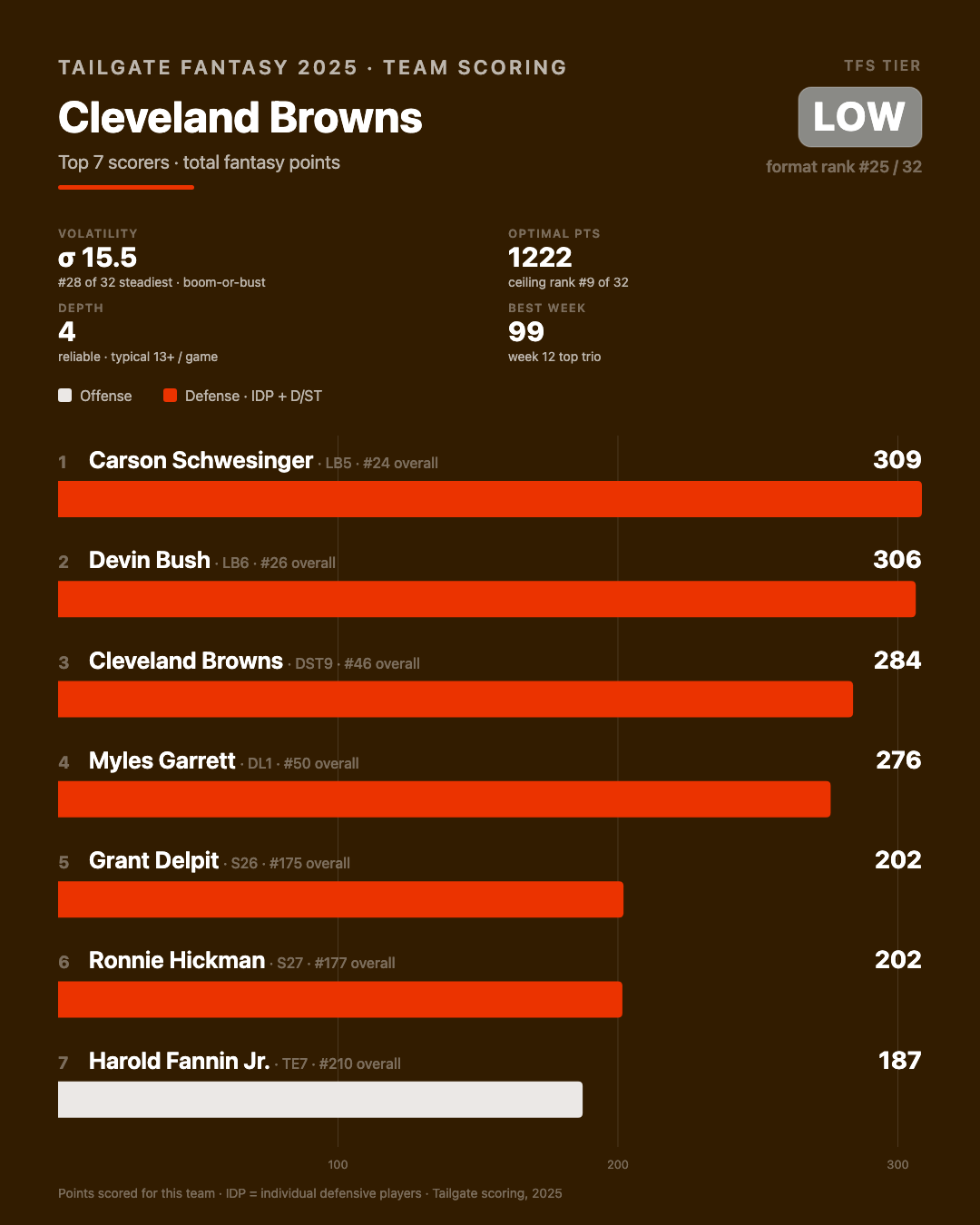
The Browns were the biggest faller on the entire board: the #9 ceiling in football finished #25 in format rank. Nobody else drops 16 places.
By raw points, Cleveland was a top-10 roster. Their top four were all defenders, and all four were legitimately excellent:
1. Carson Schwesinger (LB): 309 · LB5
2. Devin Bush (LB): 306 · LB6
3. Browns D/ST: 284 · DST9
4. Myles Garrett (DL): 276 · DL1 — the #1 pure pass-rusher in football
5. Grant Delpit (S): 202 · S26
Two linebackers, a D/ST and the best defensive lineman in the league. When it worked, it really worked: their best trio week was 99 points, and week 12 was three defenders combining for it.
So what killed them. Two things, and both are the format doing its job. First, sigma 15.5 — one of the most boom-or-bust teams in the league. Myles Garrett at sigma 11.5 and the D/ST at sigma 12.2 are exactly the kind of scorers who post 41 one week and 9 the next, because sacks and turnovers arrive in clumps. Second, and worse, only four players cleared a genuine starter's bar in a typical week. So the weekly swap keeps dragging you off the good four and onto a 12-point guy. High ceiling, low floor, no bench — that combination is why the raw scoreboard oversells this team so badly.
Here's the 2026 case, and it's the most interesting one in this batch. Carson Schwesinger went from 15.0 a game in the first half to 23.6 in the second — that's a top-3 linebacker pace over the back nine, in his rookie year, with 8 boom weeks and zero busts on the season. Devin Bush climbed too (16.5 to 19.4), and Harold Fannin Jr. gives them a real TE7. If one or two of those hold, the depth problem starts solving itself, and a #9 ceiling with an actual floor under it is a Top-tier team.
Is a boom/bust roster more fun to play, or just more painful?
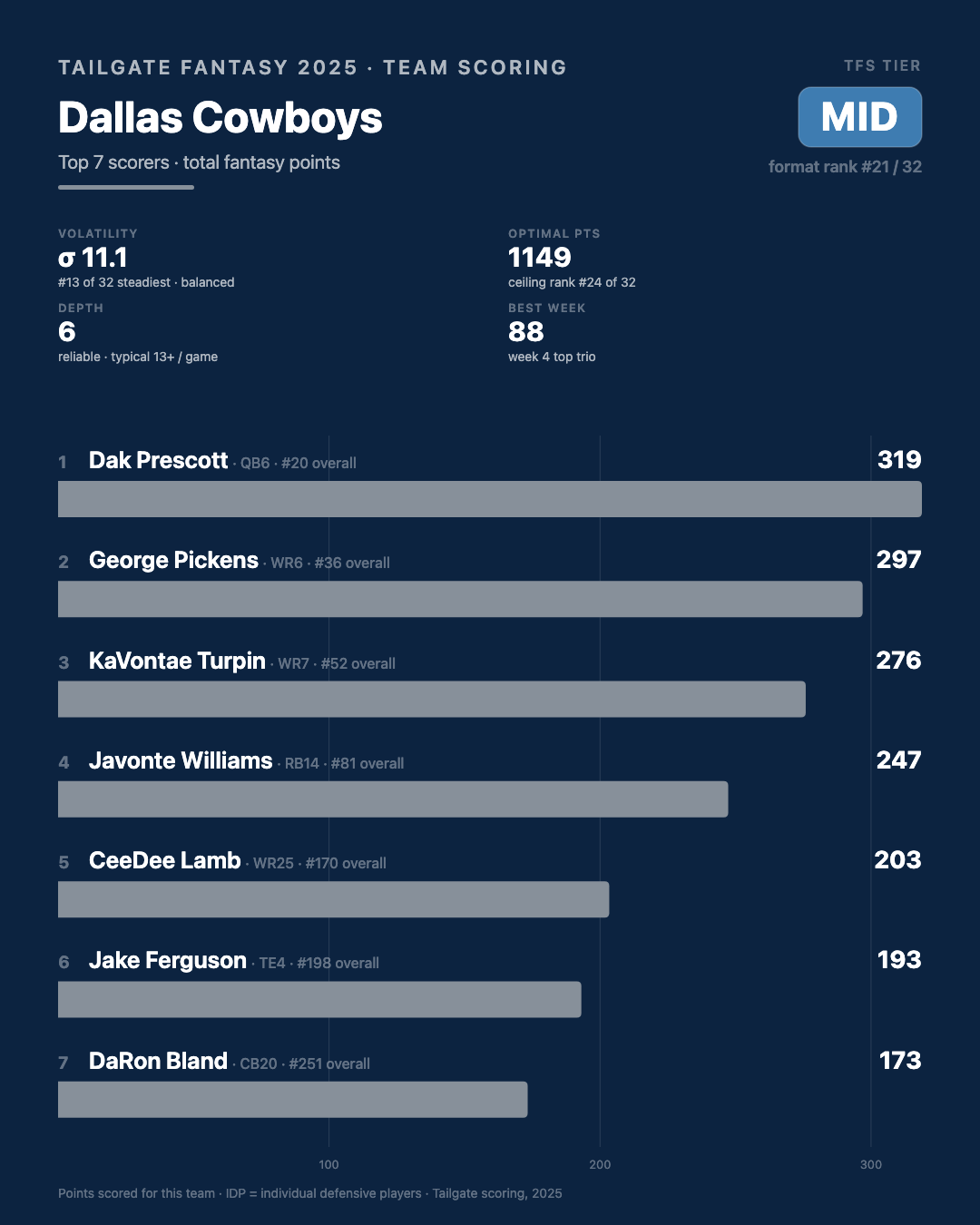
The Dallas Cowboys were the most-watched offense in football and had a top-5 finisher you've probably never started: KaVontae Turpin was WR7 in the league. CeeDee Lamb was fifth on his own team.
1. Dak Prescott (QB): 319 · QB6, #20 overall
2. George Pickens (WR): 297 · WR6
3. KaVontae Turpin (WR): 276 · WR7
4. Javonte Williams (RB): 247 · RB14
5. CeeDee Lamb (WR): 203 · WR25, in 14 games
Dallas is the only team in this batch whose top five is almost entirely offense — one defender in the top seven, against a league where five-defender top fives have been routine in this series. That makes them a genuinely different roster to play: familiar names, familiar shapes, and a top-5 that is the one you'd actually have guessed at, in an order you wouldn't.
They were the #24 offense by raw points and climb to #21 (Mid tier), on the back of six players clearing a starter's bar in a typical week. And it wasn't fragile at the top: Dak posted 8 boom weeks, Pickens 6, and Turpin 7 booms with zero busts at sigma 5.4, which for a receiver is remarkable. Their best trio week — 88 in week 4, quarterback and two receivers — is the most conventional-looking big week in this whole series.
The 2026 caution is that the back half went the wrong way almost everywhere. Javonte Williams fell from 17.8 a game to 12.4, Jake Ferguson from 14.5 to 7.8, DaRon Bland from 16.3 to 11.9, and Dak and Pickens both cooled a little. The two things that held were Turpin (17.2 to 19.4) and the general shape of the offense. If you're buying Dallas this year you're buying the top three and accepting that the back half of the roster has to be rebuilt in-season.
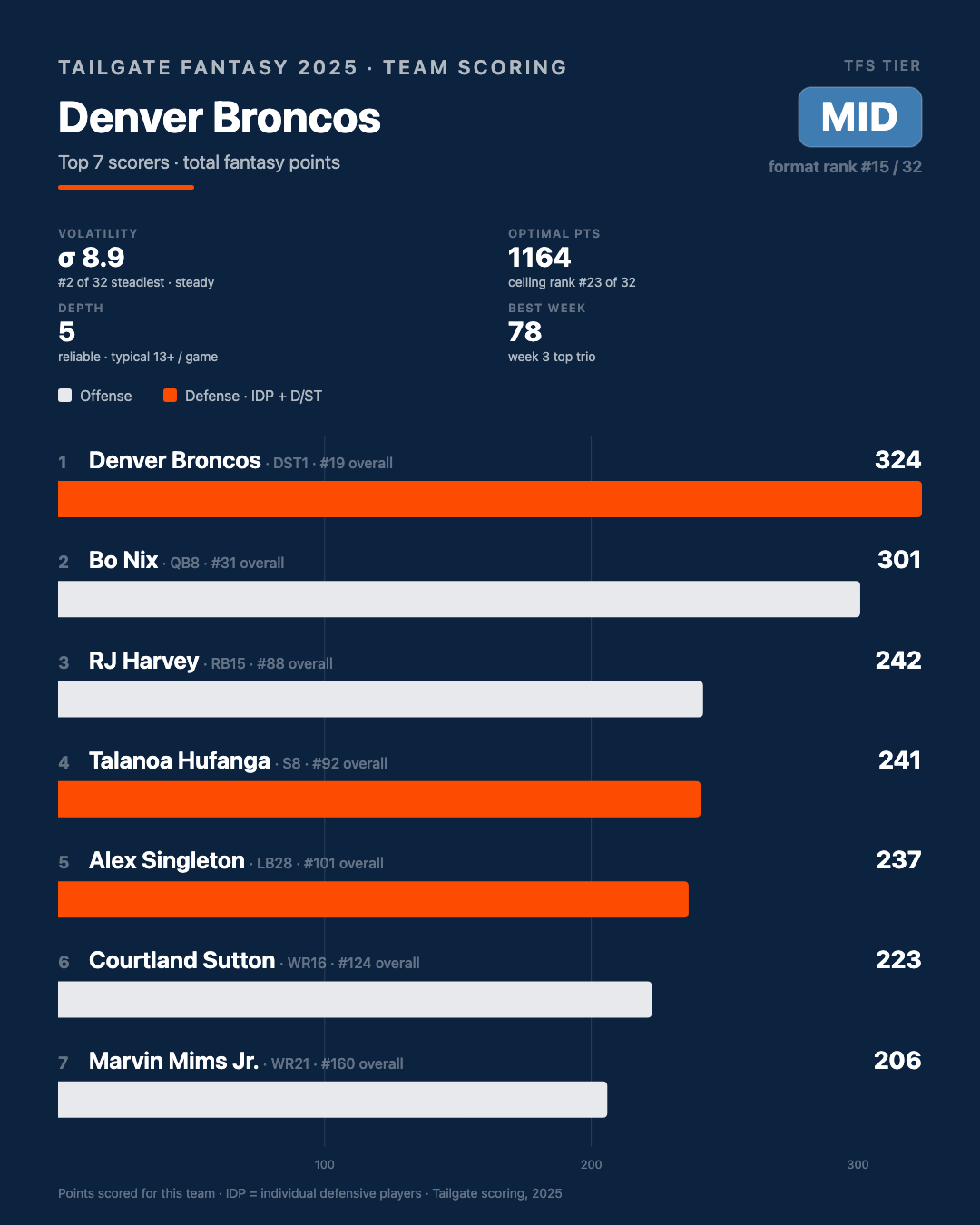
The Broncos are the safe-floor poster child, and its best fantasy player is a defense.
The Denver D/ST scored 324 points — DST1 in football, and #19 overall, ahead of most starting quarterbacks. That is not a typo and it's not a quirk of one huge week; they went for 19.1 a game with a single bust all season.
1. Denver Broncos D/ST: 324 · DST1, #19 overall
2. Bo Nix (QB): 301 · QB8
3. RJ Harvey (RB): 242 · RB15
4. Talanoa Hufanga (S): 241 · S8
5. Alex Singleton (LB): 237 · LB28
Denver's raw ceiling was only #23 of 32 — this was not a high-scoring team. But they finish #15 in format rank (Mid tier), and the entire climb comes from one number: sigma 8.9, the second-lowest volatility in the league. Their top five sit inside an 88-point band and their best week (78) is barely 30 points clear of their worst (49). Alex Singleton posted a sigma of 4.0 — the flattest scorer in this whole series so far, a guy who essentially printed 14-15 points a week no matter the opponent.
That's the whole Denver pitch in this format. You are never going to hang 100 on somebody. You are also never getting knocked out of a playoff week by a no-show, and against the boom/bust rosters we've covered — the Browns, the Raiders — the steady team wins more of those coin flips than the raw ranks suggest.
For 2026, the honest read is that the profile is the asset and the profile is stable. There's no hidden second-half surge here (Bo Nix actually cooled, 19.3 to 15.9), but nothing collapsed either, and a #1 D/ST plus a top-10 QB plus three players inside 240 points is a floor you can plan around. Denver is what you draft when you've already got one swingy team in your league and you want to be the one who never blows a week.
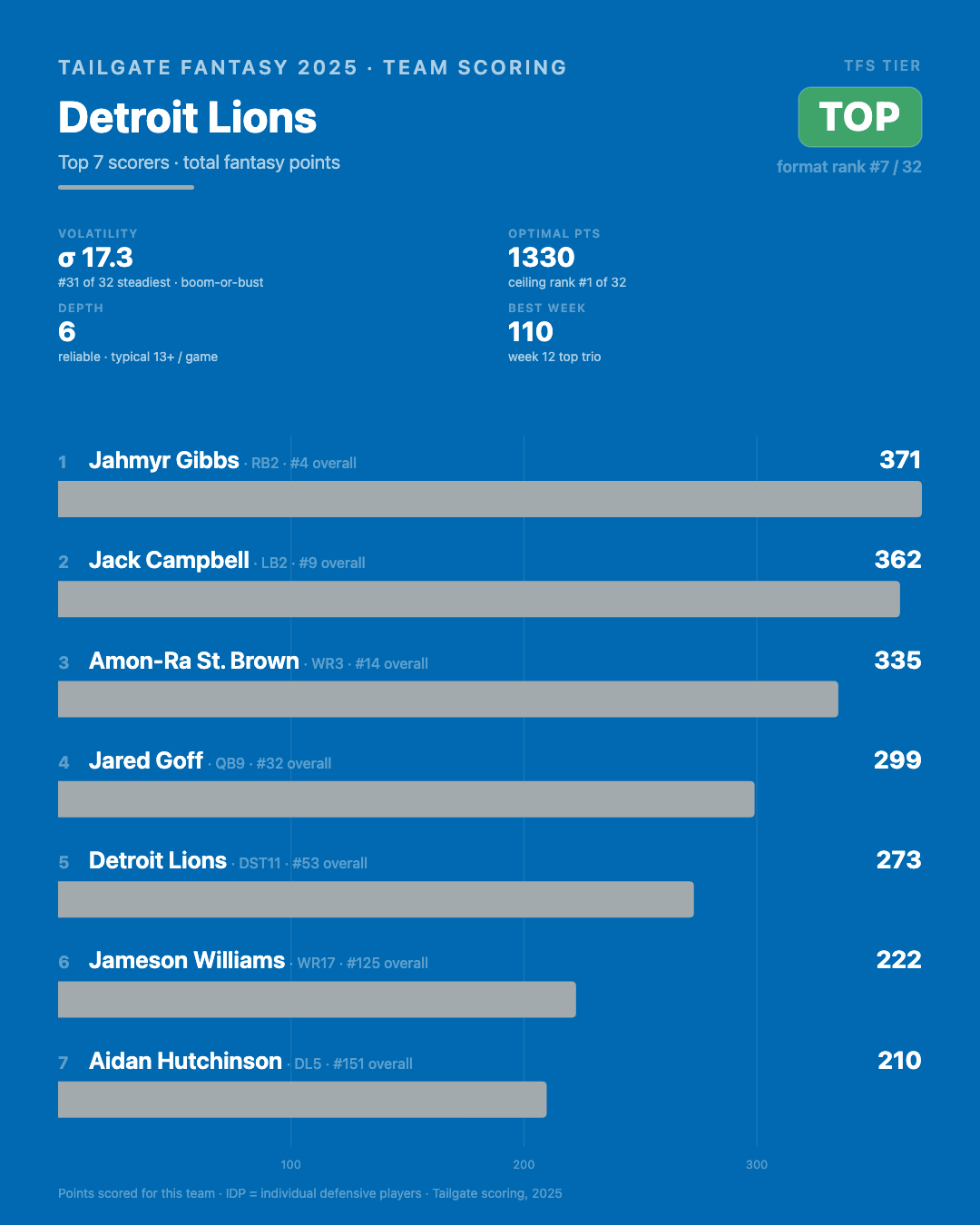
The Lions were the #1 scoring offense in football, and it finished seventh in our format. This is the post the whole tier list was built to explain.
1. Jahmyr Gibbs (RB): 371 · RB2, #4 overall
2. Jack Campbell (LB): 362 · LB2, #9 overall
3. Amon-Ra St. Brown (WR): 335 · WR3, #14 overall
4. Jared Goff (QB): 299 · QB9
5. Lions D/ST: 273 · DST11
Four players in the top 32 overall. Nobody else in football had that. Detroit's best-possible season total (1,322) was the highest in the league, and their best week — 110 points in week 12, Gibbs 55.4, St. Brown 32.4, Hutchinson 22 — is the biggest single trio of any team in the second half of the season.
So why #7? Sigma 17.1, the second-most volatile team in football, and only five players clearing a starter's bar in a typical week. The week 12 explosion is real, and so is week 1: 46 points, their floor, with Jack Campbell's 16.5 leading the team. When the top four don't go off, there's no fifth gear, and a 110 followed by a 46 is worth less in a head-to-head league than two 78s.
Note who's in that top two, though. Jack Campbell — a linebacker — was the #9 overall scorer in football at 21.3 a game with 10 booms and zero busts. He's the steadiest thing on this roster by a mile, and the Lions' fantasy identity is much more "elite RB plus elite LB" than most people think.
The 2026 read has one big arrow. Gibbs went from 18.5 a game to 24.8, Jameson Williams 9.6 to 16.1, Hutchinson 11.1 to 13.5, and Goff nudged up. The drag was defensive: the D/ST fell 20.6 to 12.0 and Derrick Barnes 13.5 to 7.4. A Detroit roster that pairs Gibbs' second-half form with a defense that stops leaking is an S-tier team, no question.
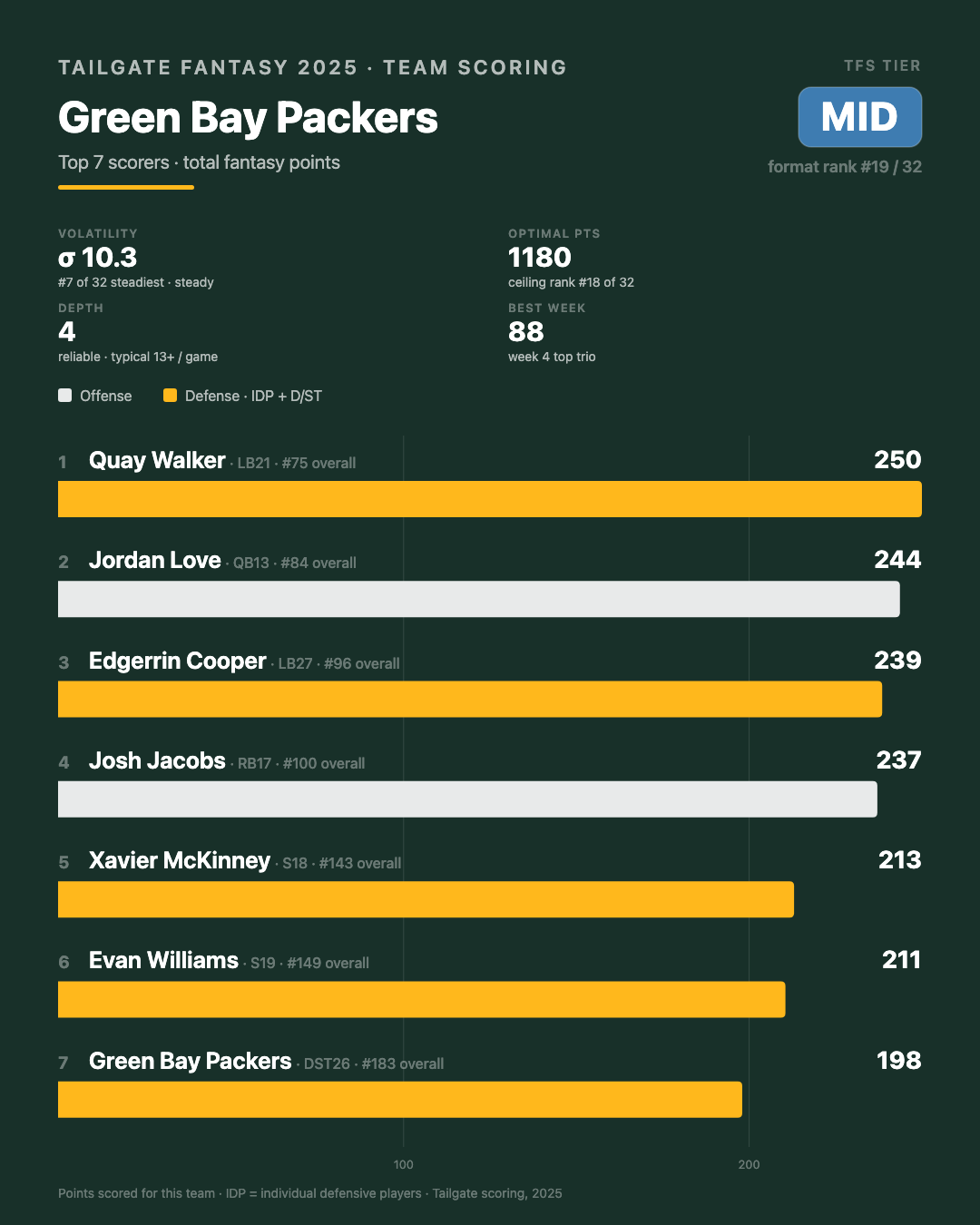
The Packers didn't have a single top-70 fantasy player last year. They still finished #18. Pure committee.
Green Bay's best scorer was linebacker Quay Walker, at #75 overall, the lowest "best player" of any team in the top half of the league. But look how tightly everyone clustered:
1. Quay Walker (LB): 250 · LB21
2. Jordan Love (QB): 244 · QB13
3. Edgerrin Cooper (LB): 238 · LB27
4. Josh Jacobs (RB): 237 · RB17
5. Xavier McKinney (S): 213 · S18
6. Evan Williams (S): 210 · S19
7. Packers D/ST: 198 · DST27
Seven guys inside 52 points, two off-ball linebackers out front, and no superstar anywhere. The very top barely wobbled: Quay Walker (6 booms, 0 busts) and Edgerrin Cooper (4 booms, 0 busts) both never posted a dud all year. In a format where you rotate two lineup spots every week, that kind of dependable core is exactly what you want.
But here's the catch, and it's the whole reason this team is a cautionary tale: the depth looks elite and isn't quite. Eight Packers averaged 13+ a game, but only four cleared that bar in a typical week. The other four got there on a boom or two and were under it most Sundays. So the committee is real, but the genuinely reliable rotation is thinner than the roster suggests.
By raw points they're the #18 offense, and with no ceiling to rise on and only middling reliable depth, they net out right about where they started: format #19, squarely Mid. The "boring but fine" pick, not the sneaky-elite one the averages make it look like.
Green Bay is the hardest team on this board to talk yourself into for 2026, and the second-half splits are why. Love went 19.3 a game before the break and 13.5 after. Jacobs went 19.5 to 12.5. The two players who could have given this roster a real ceiling both faded down the stretch, and there's no injury asterisk or rookie wall to pin it on. What held up was the young front seven: Edgerrin Cooper with 4 booms and zero busts, Evan Williams climbing to 14.5, Isaiah McDuffie more than doubling from 6.6 to 14.4. So the likely 2026 Packers are this same team with a slightly better defense, which is fine, and fine is exactly the problem. Mid is not a tier you climb out of by being dependable.
Would you rather have one stud and a bunch of scrubs, or seven solid guys and no star?
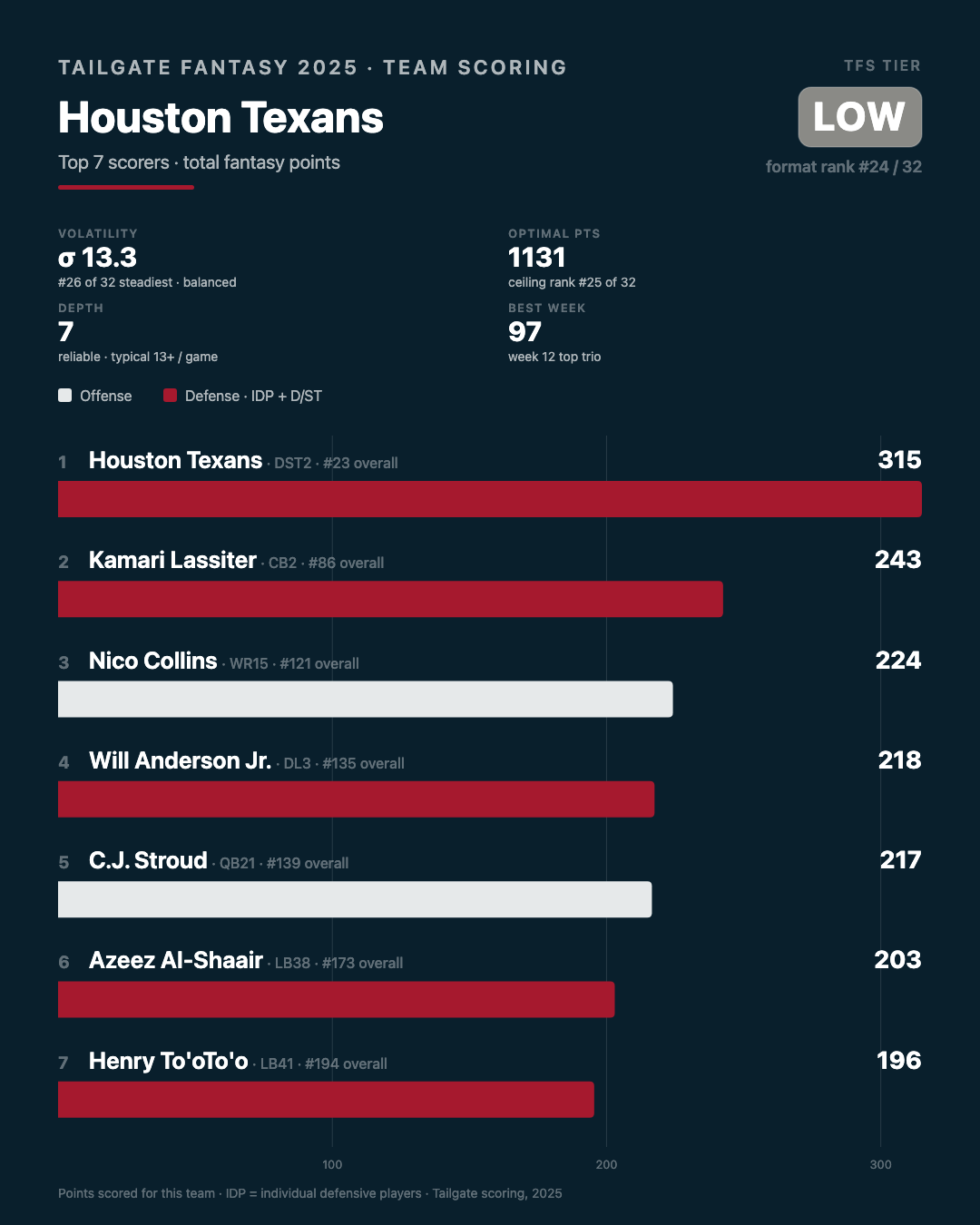
The Houston Texans are the cleanest example of this format flipping the script: Houston's defense outscored their offense, top to bottom.
The Texans were only the #25 offense by raw points, and Low tier once you factor in sigma 13.3. But here's the thing: five of their top seven scorers were defenders, and they weren't just good for Houston, they were elite leaguewide.
1. Texans D/ST: 315 · #2 defense in all of football
2. Kamari Lassiter (CB): 243 · #2 cornerback
3. Nico Collins (WR): 224 · WR16, first skill guy!
4. Will Anderson Jr. (DL): 218 · #3 defensive lineman
5. C.J. Stroud (QB): 217 · QB21, 5th on his own team
The #2 overall pick and face of the franchise was the 5th-best fantasy option in his own building, and the #21 QB overall. In a normal league Stroud is an early-round pick. Here, if you rostered Houston, you were starting the #2 defense, #2 corner, and #3 lineman in the league and barely thinking about the QB.
This is the parity point that makes the format fun: a bottom-tier team can still be stacked with top-3-at-their-position individual assets. When tackles, sacks, and takeaways score, a great defense on a so-so team beats the big offensive name every week. Draft the unit, not the QB.
The defense isn't the 2026 question. It wasn't a spike that faded, it got better as the year went, from 16.2 a game in the first half to 20.6 in the second, six booms against one bust. That unit is the asset and it isn't going anywhere.
The question is Stroud, and it's a bigger one than his QB21 suggests. He's heading into year four, still on his rookie deal with the fifth-year option picked up and no extension signed, which means 2026 is the season that decides what he's worth. His problem is pressure: get to him and the whole offense stops, and the tape says that's the gap between the rookie-year version everybody remembers and the one that finished as the #21 fantasy quarterback. Nothing about a contract year makes pressure easier to handle. What helps is Tank Dell, who missed all of 2025 and comes back as a second real threat opposite Nico Collins. Collins was a 14.9 a game, 5 boom, zero bust receiver while carrying that room by himself; a quarterback who struggles under pressure benefits more than most from a second guy who gets open fast. Give Stroud that plus a defense scoring 20 a game on its own, and Houston is not a Low-tier team.

The Colts had the best single game by any player in the countdown so far — Jonathan Taylor, 52.1 points, week 10 — and a safety was their second-best scorer all season.
1. Jonathan Taylor (RB): 367 · RB4, #7 overall
2. Nick Cross (S): 260 · S3
3. Zaire Franklin (LB): 254 · LB18
4. Daniel Jones (QB): 233 · QB16
5. Colts D/ST: 232 · DST17
That week 10 line is the fantasy dream: Taylor 52.1, Zaire Franklin 26.5, Alec Pierce 20.9 — 100 points from one roster. Indianapolis is a genuinely well-shaped team for this format: sigma 11.1, 12th-steadiest in the league, five reliable weekly options, a top-10 overall player, and a top-3 safety nobody outside Indiana could name. Ceiling #15, format rank #14 (Mid tier) — one of the very few teams the two systems agree on almost exactly.
The catch is the shape of their season. Week 14 was 49 points, and their entire top four was missing or quiet — Michael Pittman's 19.4 led the team. That's what happens when the roster is built around one runner and a defense.
The 2026 read is genuinely split, and worth arguing about. Zaire Franklin went from 11.1 a game to 19.3, Cam Bynum from 9.7 to 14.3, Alec Pierce 10.9 to 14.4. But Taylor fell 24.9 to 17.8, Pittman collapsed 16.0 to 7.3, the D/ST 16.7 to 10.2, and Daniel Jones 20.0 to 13.3 before missing time. The Colts finished the year as a linebacker-and-secondary team wearing an offense's reputation. If Taylor's second half was workload and not decline, this is a top-10 format roster.

The Jaguars were the quietest Top-tier team in football. Jacksonville was the #17 offense by raw points and finished #11 in format rank, and I'd argue they're the cleanest example in this whole series of what the format actually rewards.
1. Trevor Lawrence (QB): 340 · QB4, #13 overall
2. Foyesade Oluokun (LB): 289 · LB9
3. Jaguars D/ST: 277 · DST10
4. Travis Etienne Jr. (RB): 256 · RB11
5. Parker Washington (WR): 233 · WR11
A top-4 quarterback, a top-10 linebacker, a top-10 defense, a top-11 back and a top-11 receiver. No superstar, no #1-overall anything — just five genuinely startable players at five different shapes, which means the mandatory weekly swap can never corner you. Six players cleared a starter's bar in a typical week, and the whole thing ran at sigma 10.0, comfortably on the steady side.
Look at the individual consistency, too. Lawrence: 7 boom weeks, zero busts. Oluokun: sigma 5.5, 6 booms, one bust, in 17 games. Those are the two guys you'd build around, and neither of them ever disappeared. Their ceiling still showed up when it mattered — 100 points in week 15, D/ST plus quarterback plus running back.
The 2026 read is the best in this batch, because the improvement is at the top. Trevor Lawrence went from 17.2 a game in the first half to 22.5 in the second — QB1-overall pace over the back nine. The D/ST climbed from 13.5 to 18.8, Parker Washington from 11.9 to 17.3, Etienne from 13.8 to 16.2. Four of their five best players finished the season better than they started it, on a roster that was already deep and already steady. If you want one team from the middle of this list to be a tier higher in 2026, it's this one.
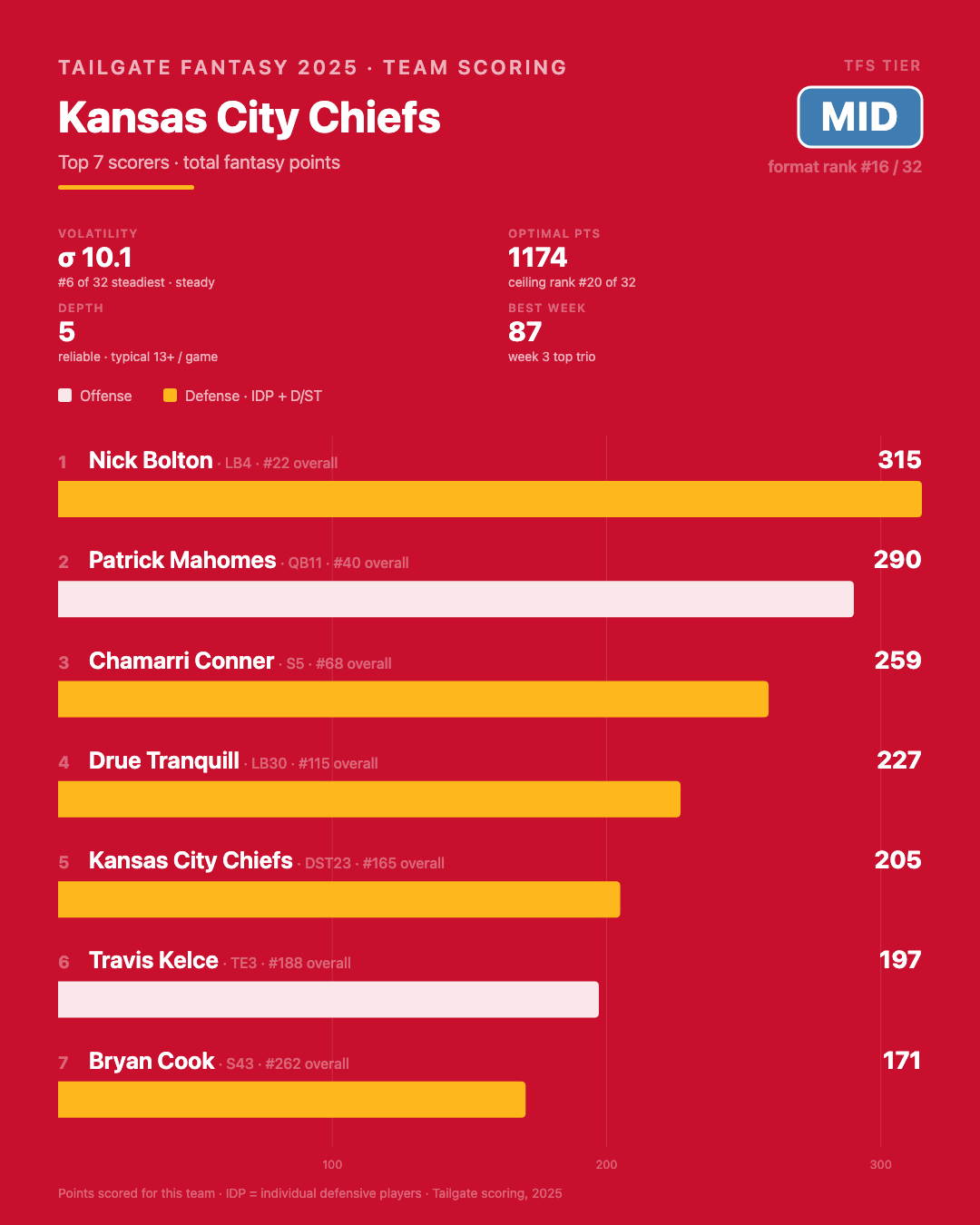
The Chiefs [were] the dynasty, and in this format the dynasty finished #16 of 32. Dead middle. Here's the part that explains it, and it isn't the part everyone assumes.
1. Nick Bolton (LB): 315 · LB4, #22 overall
2. Patrick Mahomes (QB): 290 · QB11
3. Chamarri Conner (S): 259 · S5
4. Drue Tranquill (LB): 227 · LB30
5. Chiefs D/ST: 205 · DST23
Nick Bolton outscored Patrick Mahomes, Chamarri Conner matched him point for point per game over the second half, and Travis Kelce finished sixth on his own team. Five of Kansas City's top seven scorers were defenders. If you drafted this roster expecting to win through the two most famous players in football, you spent the year starting linebackers instead.
But the talent isn't the problem — the depth is. The Chiefs were the sixth-steadiest team in the league at sigma 10.1, which is genuinely valuable, and then only five players cleared a starter's bar in a typical week. With a mandatory two-of-three swap every week, five options is the bare minimum: you're never picking your best lineup, you're picking the least-bad one. Their best trio week was 87 in week 3 — a D-lineman, the D/ST and a linebacker, not a single household name in it. Their worst was 50 in week 2.
The 2026 read is genuinely encouraging on defense and genuinely uncertain on offense. Bolton went from 16.6 a game to 20.8, Drue Tranquill from 10.0 to 17.1, Bryan Cook from 8.5 to 11.8. The other direction: the D/ST slipped 13.2 to 10.8, Kelce 12.7 to 10.4, and Mahomes played only five games after week 9. A healthy 17-game Mahomes on top of that linebacker room is a Top-tier roster. That's the bet.
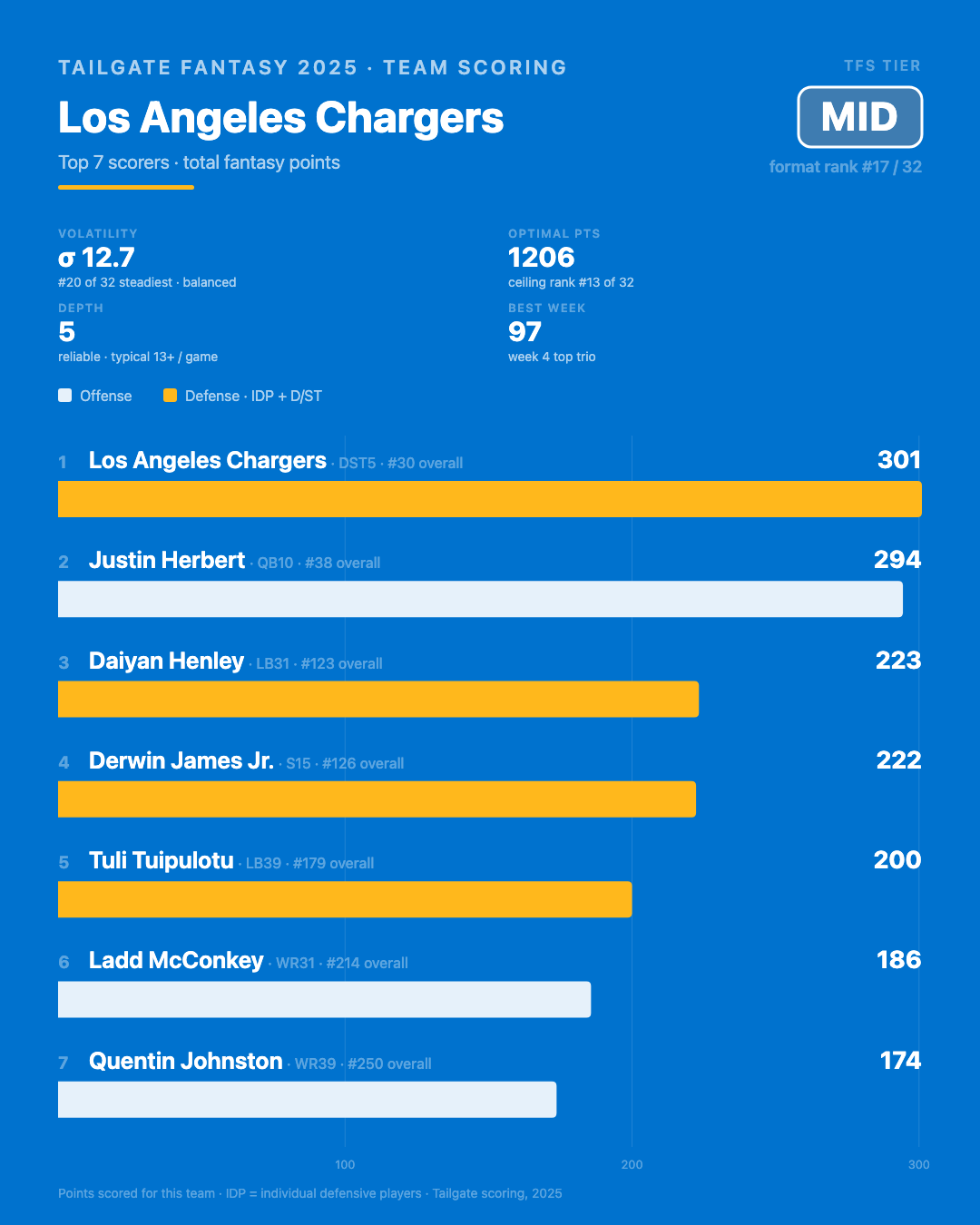
For the third time in this series a D/ST is a team's #1 fantasy scorer. If you've been reading along, that should be starting to feel less like a fluke and more like the format telling you something.
1. Chargers D/ST: 301 · DST5
2. Justin Herbert (QB): 294 · QB10
3. Daiyan Henley (LB): 223 · LB31
4. Derwin James Jr. (S): 222 · S15
5. Tuli Tuipulotu (LB): 200 · LB39
Los Angeles had a real #13 ceiling — top half of the league, 1,206 optimal points — and slid to #17 in format rank. The cause is the pair of numbers this series keeps coming back to: sigma 12.7 and only five players clearing a starter's bar in a typical week. Tuli Tuipulotu is the extreme case, a sigma of 11.5 with 3 boom weeks and 5 busts — a 45-point week 4 and a pile of single digits around it. That's a player who wins you one week and loses you two.
The Chargers' best trio week was 97 points in week 4, a D/ST, a linebacker and a running back. Their worst was 45. Same roster, seven weeks apart.
The 2026 split is unusually clean, and it cuts both ways. The defense got better as the year went on — D/ST 16.2 a game up to 19.4, Tuipulotu 11.6 up to 13.7 — while the offense fell off a cliff: Herbert 21.1 down to 15.0, Ladd McConkey 13.4 down to 9.3, Quentin Johnston 14.4 down to 9.8. Omarion Hampton's nine games at 15.9 a game are the one offensive bright spot worth holding onto. A defense-led Chargers roster is a perfectly good thing to own in this format. Just know that's what you're buying, because the version of this team that scores through Herbert stopped showing up in November.

The Rams were the #1 team in the format, out of all 32. The best roster you could have owned last season, and it isn't especially close.
1. Puka Nacua (WR): 375 · WR1, #3 overall
2. Matthew Stafford (QB): 359 · QB2, #10 overall
3. Rams D/ST: 296 · DST7
4. Nate Landman (LB): 285 · LB11
5. Kam Curl (S): 268 · S1
The #1 receiver, the #2 quarterback, and the #1 safety in football on one roster — plus a top-7 defense and a top-11 linebacker. Ceiling #2, format rank #1 (S tier), and the reason it's #1 rather than #2 is everything under the headline: eight Rams cleared a starter's bar in a typical week, second-deepest in the league, at sigma 11.6. Elite, steady, and deep at once. Nobody else managed all three.
The upside week is absurd — 104 points in week 16: Puka 46.5, Stafford 30.9, and a cornerback, Josh Wallace, for 26.6. The floor held too: they cleared 68 points in every week but one. Even their worst week (54, week 17) came with Puka rested and the roster still produced a startable trio.
The 2026 read is the calmest on this list, which is its own kind of endorsement. Puka and Stafford both got slightly better after the break (23.1 to 23.7 and 20.7 to 21.5), Kyren Williams held at 15-plus, and Kam Curl stayed a top safety. The soft spots were all defensive: the D/ST slid 20.0 to 15.1, Byron Young 15.8 to 9.9, Jared Verse 12.7 to 9.2.
And then Los Angeles went out and fixed exactly that. They traded for Myles Garrett and brought Aaron Donald back out of retirement. Garrett was the #1 defensive lineman in football last season — 276 points, 16.2 a game, all 17 games, with a 40.5 in week 11 and 35 in week 12. Garrett alone put up 61 more points than the Rams' best defensive lineman last season (Byron Young, 215) and 92 more than Verse, who also led this roster in bust weeks with five. Donald doesn't have a 2025 line to point at, for the obvious reason, but the last time he played a down he was the best interior rusher of his generation. A generational edge and a generational three-technique on the same defensive line, on a roster that was already #1 — and in this format both of them are DL-eligible, so you can start them.
That's the thing worth sitting with. The Rams' one weakness was the pass rush pulling their D/ST down, and they answered it with the position that scores best in our sheet. A roster whose two best players are a 27-year-old receiver and a quarterback in his late 30s is a genuine "win now" pick — and they just spent the offseason making the win-now case louder.
The #1 roster in football added the #1 defensive lineman in football. Is that a title, or is that a cap problem?
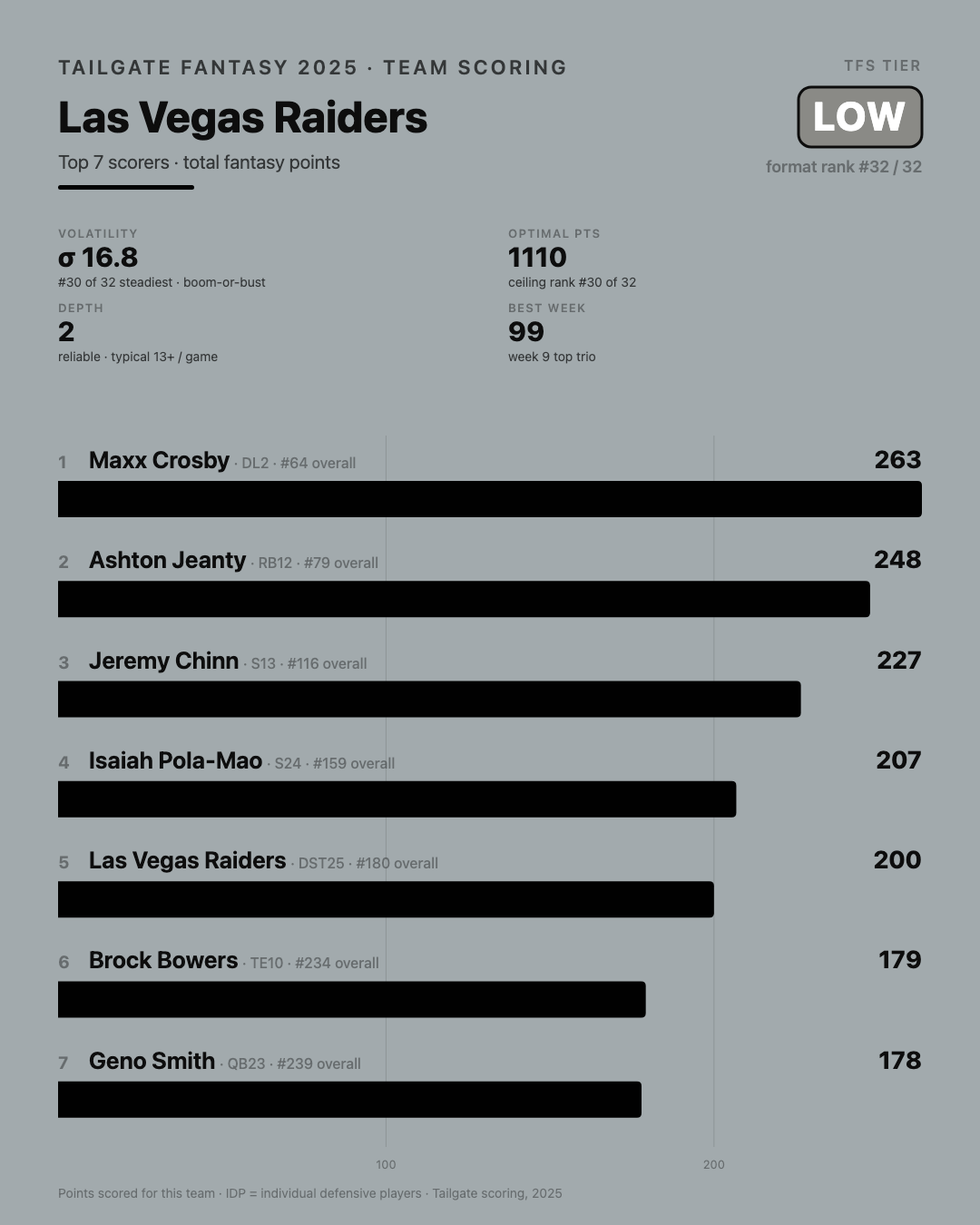
The Raiders were the dead-last fantasy team last season, and it had a top-2 edge rusher, a top-12 rookie RB, and a top-10 TE. Here's why all that talent still finished #32 of 32.
The Raiders are the most interesting near-bottom team you'll see, because on paper they're stacked with names you actually know:
1. Maxx Crosby (DL): 263 · DL2
2. Ashton Jeanty (RB, rookie): 248 · RB12
3. Jeremy Chinn (S): 227 · S13
4. Isaiah Pola-Mao (S): 207 · S24
5. Las Vegas Raiders D/ST: 200 · DST25
That's the #2 defensive lineman in all of football, a top-12 rookie running back, and, not even in the top five, Brock Bowers, a top-10 TE who only suited up 12 times. So how does a roster like that finish dead last, #32 of 32? Two things the format punishes harder than raw talent:
-Volatility, sigma 16.8, one of the swingiest teams in the league. Boom-or-bust: Bowers dropped a 43 in week 9, Tre Tucker a 44 in week 3, and then both vanished the next week.
-Depth: just two players cleared a genuine starter's bar in a typical week (median 13+/game), the thinnest in the entire league. And that's the tell. Several Raiders averaged a startable score off a boom or two, but in a typical week they were under it. You're not forced deep down the bench, but you do have to swap 2 of your 3 starters every week, and behind the top pair the reliable quality falls off a cliff, so those forced swaps kept dragging a stud out for a boom-or-bust flier.
That's the exact double-edge our tier list is built to catch: a high ceiling with no floor. The Raiders could win you a single week outright off a Crosby/Jeanty/Bowers spike, and then hand you a loss the very next week when the studs no-showed and the bench had nothing behind them. Great names, no reliability.
The parity flip still holds, though. Even the worst team in the format let you build a week around the #2 edge rusher in football or ride a rookie feature back. Dead last here didn't mean no assets; it meant no depth behind them.
Which is also why they're the most fixable last-place team you'll see. The parts that are genuinely hard to acquire are already on the roster: Ashton Jeanty played all 17 as a rookie and was the same player in December as in September (14.5 then 14.6), Crosby actually rose down the stretch, 15.5 up to 19.4, and Bowers managed 14.9 a game in only 12 appearances. Depth is the cheap part. Las Vegas finished #32 because two startable bodies is not enough in a format that makes you swap two spots every week, not because the top of the roster was bad. The one thing that won't fix itself is under center: 11.9 a game from the quarterback spot is what keeps a roster this talented in the basement.
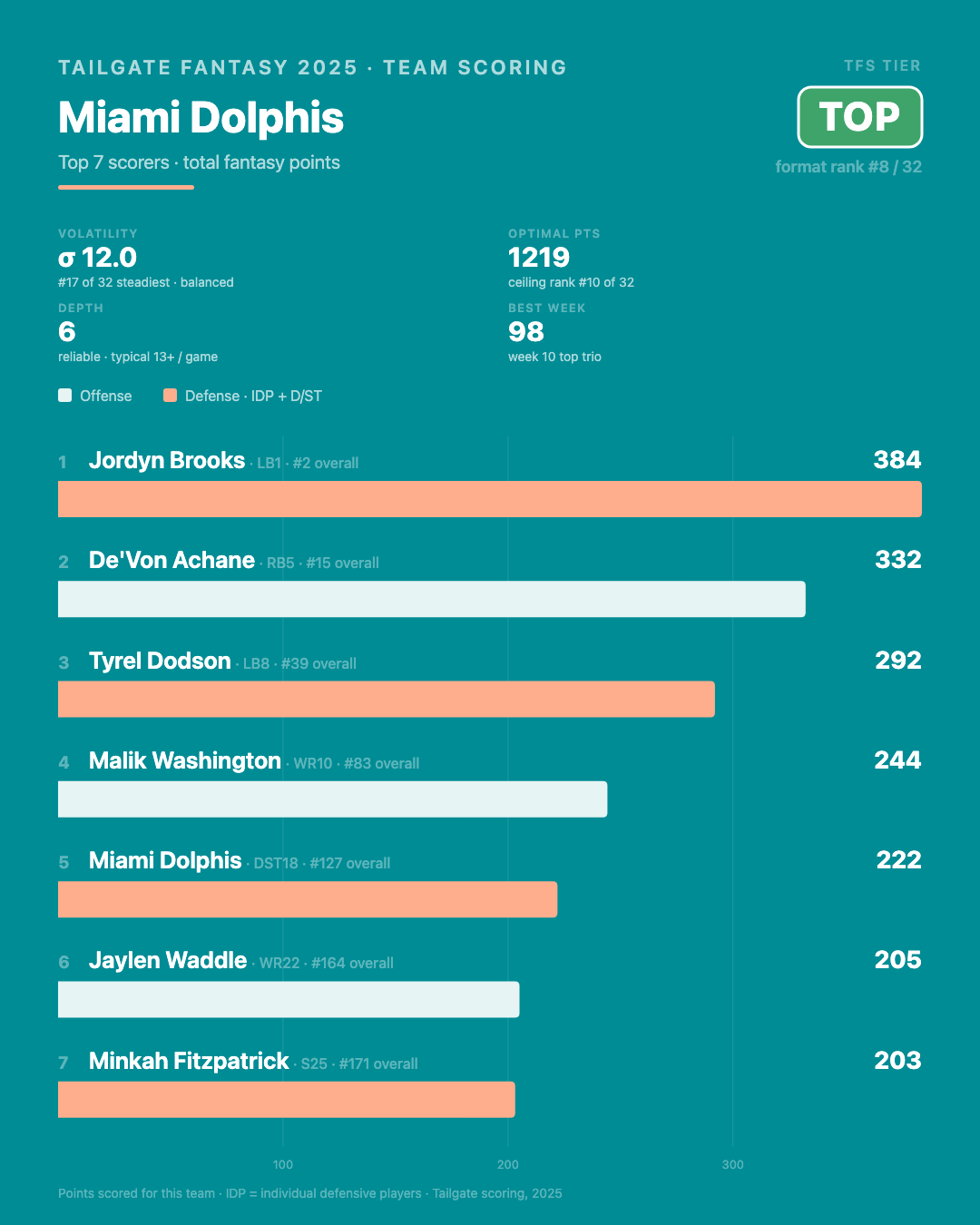
Here's the number that broke everyone's brain when we ran it: the #2 overall fantasy scorer in football last season was a linebacker.
1. Jordyn Brooks (LB): 384 · LB1, #2 overall
2. De'Von Achane (RB): 332 · RB5, #15 overall
3. Tyrel Dodson (LB): 292 · LB8
4. Malik Washington (WR): 244 · WR10
5. Dolphins D/ST: 222 · DST18
Jordyn Brooks: 22.6 a game, 10 boom weeks, zero busts, 17 games played. Not one week under the bar all season. Behind him, Achane put up 20.8 a game with zero busts of his own, and Tyrel Dodson gave Miami a second top-10 linebacker. Two LB1-caliber seasons on one roster is not a thing that usually happens.
That's how a #10 ceiling becomes format rank #8 (Top tier): sigma 12.0, six players clearing a starter's bar in a typical week, and the two best players on the roster both being metronomes. Week 10 was 98 points — Achane 40.5, Brooks 30, the D/ST 27. Even their floor mostly held: outside a 43-point week 18 with the season already decided, Miami never dropped below 60.
The 2026 read is unusually clean, because the good stuff is still trending up. Brooks got better in the second half (22.2 to 23.1), Achane too (20.3 to 21.4), the D/ST nearly doubled 9.3 to 17.2, and Minkah Fitzpatrick went 13.0 to 17.3. The receivers went the other way — Washington 16.3 down to 12.2, Waddle 14.2 to 11.1, Tua 13.0 to 9.9 — so this is a defense-and-backfield roster now, whatever the depth chart says.

The Vikings owned the single biggest week any team scored all season — 122 points in week 3 — and Justin Jefferson had nothing to do with it.
1. Vikings D/ST: 287 · DST8
2. Eric Wilson (LB): 283 · LB12
3. Blake Cashman (LB): 256 · LB17
4. Justin Jefferson (WR): 205 · WR23
5. Isaiah Rodgers (CB): 192 · CB18
Minnesota is the fifth D/ST-led team of the countdown — Houston, Denver, the Chargers, Pittsburgh, now the Vikings — and the only one where a cornerback was the reason. Week 3: Isaiah Rodgers 49.2, the Vikings D/ST 46.0, Ivan Pace Jr. 27.0. Nobody in football had a bigger week, and none of those three were rostered in most leagues.
Two Sundays later, week 5: 49 points. Same roster. That's the whole team in one sentence — sigma 17.2, the most volatile team in football, with just four players clearing a starter's bar in a typical week. Ceiling #22 slides to format rank #29 (Low tier), and it isn't a punishment for being bad. It's a punishment for being unpredictable and shallow at the same time: you have to swap two starters every week, and on this roster there was frequently nobody good to swap to.
The Jefferson line is the one nobody believes. The best receiver in football scored 12.1 a game — WR23, #166 overall — with one boom week against three busts, and he fell from 15.5 a game in the first half to 9.0 in the second. Great real-life receiver, mediocre fantasy asset in a season where his quarterback situation never settled.
The 2026 read is defense, again. Blake Cashman went from 16.4 a game to 21.2 and finished at 19.7/gm in 13 games — LB17 on two-thirds of a season. Dallas Turner nearly doubled, 7.4 to 12.6, and the D/ST climbed 15.5 to 18.1. Falling: Jefferson, and Rodgers back down 13.6 to 9.3 once the pick-sixes dried up. If Cashman plays 17 and Turner keeps the arrow up, this is a top-15 defensive core attached to a #29 team.

The Patriots were the team with the #1 cornerback in football and one of the steadiest rosters in the league.
1. Drake Maye (QB): 358 · QB3, #11 overall
2. Marcus Jones (CB): 264 · CB1
3. TreVeyon Henderson (RB): 229 · RB19
4. Patriots D/ST: 220 · DST19
5. Robert Spillane (LB): 208 · LB36
Sigma 9.8 — the fourth-steadiest team in football. Drake Maye put up 21.1 a game with nine boom weeks and zero busts, which is about as safe as a quarterback gets. Marcus Jones was CB1, the best corner in the format, and he had a 38-point week in week 4 that nobody saw coming.
And New England still slid from ceiling #7 to format rank #13 (Mid tier), because of one number: only three Patriots cleared a starter's bar in a typical week, tied for fewest in the league with Buffalo. Steadiness is worth a lot in this format, but you have to swap two starters every week, and the fourth-best option here was a defense averaging 12.9. Their best week, 91 in week 3, came on Robert Spillane's 42.7 — a linebacker who played 13 games and led the team exactly once.
The 2026 read is the most encouraging of anyone in the Mid tier, and it's all about depth arriving. TreVeyon Henderson went from 9.8 a game to 17.6, Rhamondre Stevenson 9.6 to 17.0, Jack Gibbens 7.1 to 14.6. That's three new startable options in the back half of the season, on the exact team whose only real flaw was not having any. Falling: Marcus Jones 18.0 to 12.8, Spillane, and the D/ST. If the backfield holds its second-half form, a Top-tier ceiling is right there.
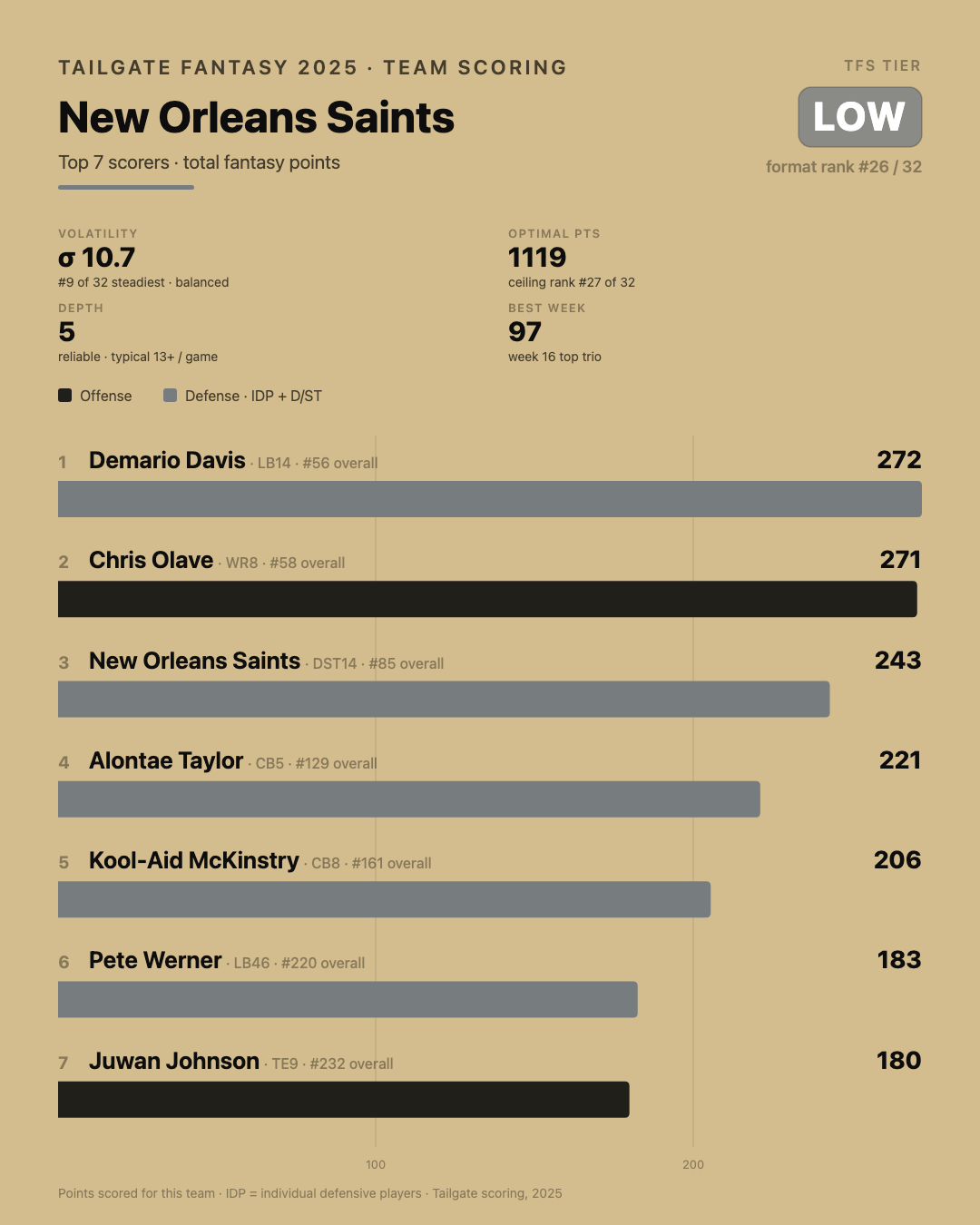
A 36-year-old linebacker was the Saints' top fantasy scorer last year, by a point and a half over Chris Olave.
New Orleans was only the #27 offense by raw points, but they're my favorite example of the scoreboard lying to you. They were one of the steadiest rosters in the league (sigma 10.7, top-10 in week-to-week consistency), with a solid core of startable defenders.
Leading the way:
1. Demario Davis (LB): 272 · LB14
2. Chris Olave (WR): 271 · WR8
3. Saints D/ST: 243 · DST14
4. Alontae Taylor (CB): 221 · CB5
5. Kool-Aid McKinstry (CB): 206 · CB8 (Oooh Yeah! IYKYK)
Veteran linebacker Demario Davis edged Chris Olave, a genuine top-8 receiver, by a point and a half for the team lead, and two top-9 corners cleared 200 behind them. Davis himself: 5 booms, zero busts. No true superstar, but a deep, defense-first bench with no weak weeks, which is exactly what wins you a must-win H2H game.
Plug that steadiness and depth into our tier formula and the Saints still climb, from ceiling #27 up to format #26, and they remain one of the few offenses the raw scoreboard genuinely underrates. Two top-9 corners, a top-8 receiver, and no weak weeks: "bottom-10 offense" and "team you actually want to roster" are not the same thing.
The 2026 question is what happens when the 36-year-old stops. Davis went 19.0 a game before the break and 13.3 after, which is what the back nine of a great career usually looks like, and he plays next season at 37. Normally that guts a defense-first roster. Here it might not, because everyone else on the list was moving the other direction: Alontae Taylor climbed from 10.8 to 15.0, the D/ST from 12.4 to 16.0, and Olave finished at 18.8 a game after the break with 5 booms and zero busts on the year. Davis built this floor. He isn't the one holding it up anymore, and that's the whole difference between a team aging out and a team turning over.
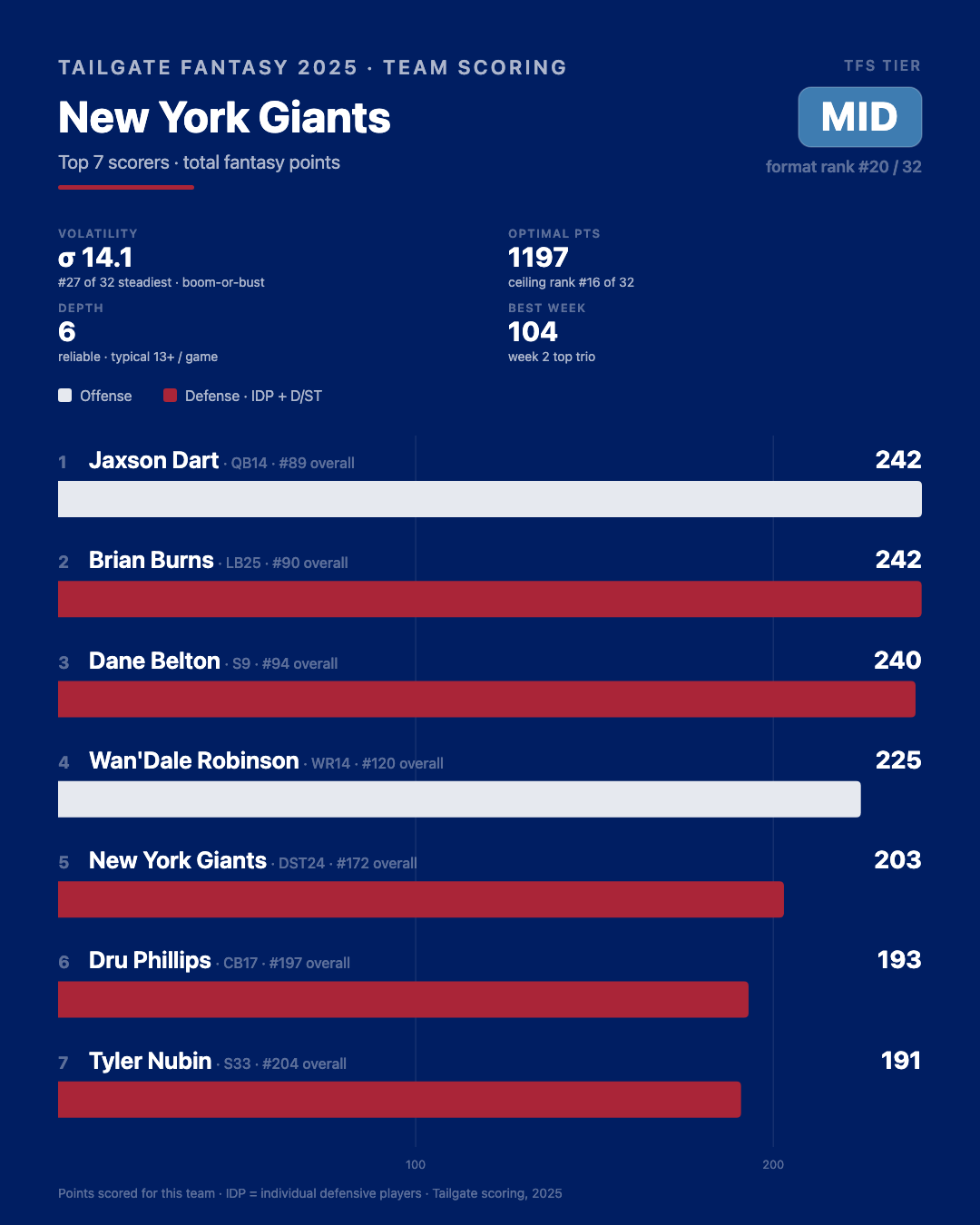
The New York Gians were the most balanced roster in football, for better and worse.
You draft 3 players from one team and have to swap two out every week, for other guys on your roster, so a flat, deep team where the next option is about as good as the last is genuinely valuable here. Nobody was flatter than the Giants:
1. Jaxson Dart (rookie QB): 242 · QB14
2. Brian Burns (LB): 242 · LB25
3. Dane Belton (S): 240 · S9
4. Wan'Dale Robinson (WR): 225 · WR14
5. Giants D/ST: 203 · DST24
Their top five finished within three points of each other. No stress, no must-start, no bust; you could close your eyes and pick and land around 14/game. Their best player was only #89 overall, and not a single Giant cracked the top 80. By raw points that's the #16 offense of 32.
Here's the wrinkle. That balance was player-level, but the team score still swung hard, sigma 14.1, because with no single star, everybody ate in a blowout and nobody ate when the Giants got blown out. That kind of volatility drags a team down in our format.
What keeps the Giants from cratering is the flip side of the same balance: six players cleared a genuine starter's bar in a typical week, so the mandatory weekly swap still lands on someone useful. Net it out and they slide from ceiling #16 to a format rank of #20 (Mid tier). A deep, swingy, no-stars team that's the very definition of fine: great for quietly banking points on a season-long leaderboard, just don't expect it to win you a shootout.
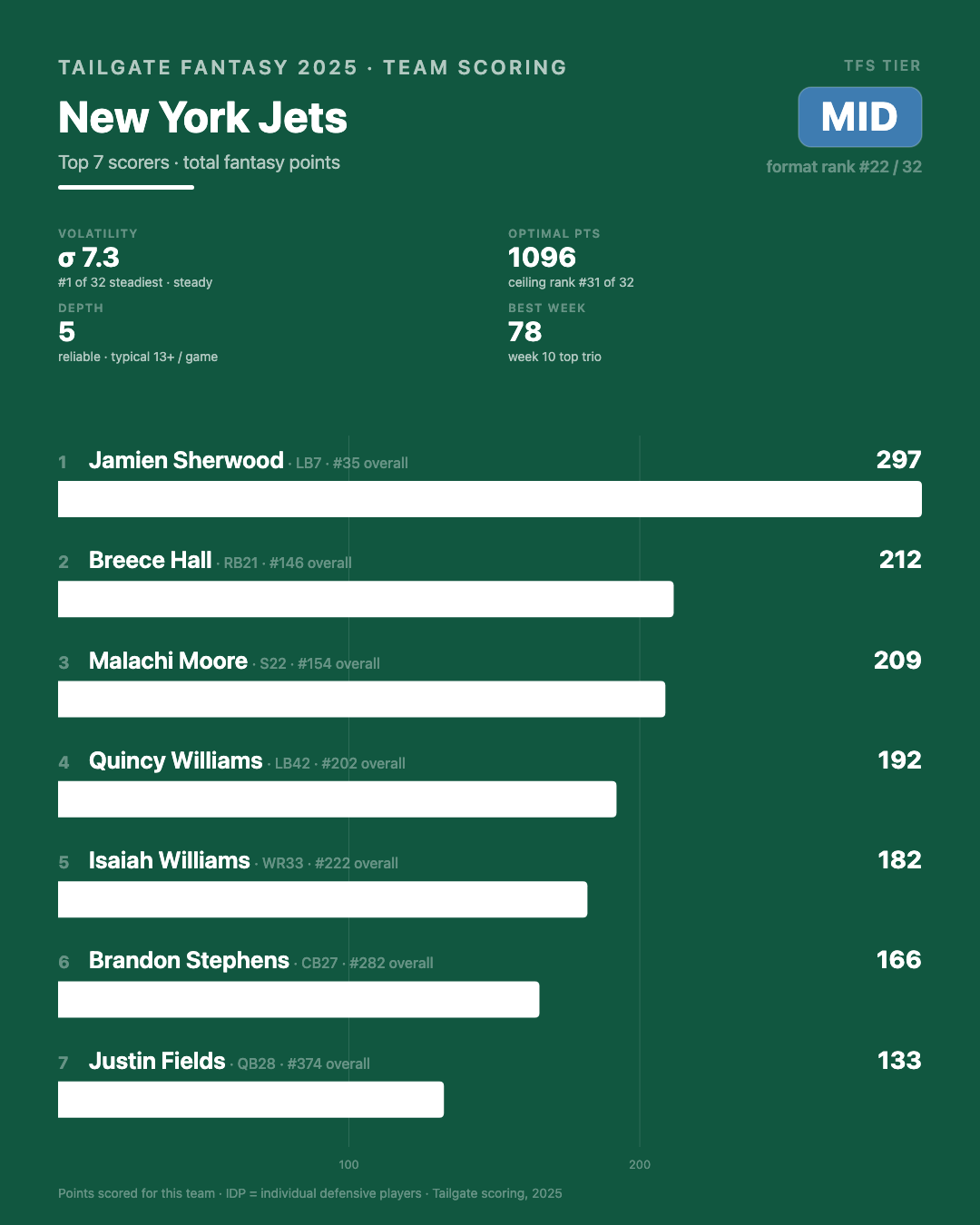
The Jets were the most boring team in football, and in our format that turns out to be a compliment.
The Jets had the #31 ceiling of 32 — only Washington's best-possible trio was worse. But they were also the single most consistent team in the league, sigma 7.3, by a comfortable margin. Their best trio week all season was 78 points and their worst was 51. That 27-point range is the narrowest in football; the average team swings twice that.
1. Jamien Sherwood (LB): 297 · LB7
2. Breece Hall (RB): 212 · RB21
3. Malachi Moore (S): 209 · S22
4. Quincy Williams (LB): 192 · LB42
5. Isaiah Williams (WR): 182 · WR33
Two linebackers, a safety, and the only offensive skill player anybody drafted sits second. Justin Fields played 9 games and finished QB28, seventh on his own team.
So how does the #31 ceiling end up at a format rank of #22? Because in this format you're not being graded on your one perfect week. You have to field a trio every week, swapping two of three, and the Jets never once left you with nothing. Five players cleared a genuine starter's bar in a typical week, and Sherwood in particular put up 5 boom weeks and zero busts. You will not win a shootout with this roster. You will also never open the app on Sunday morning and find a zero staring back at you, and across a 17-week H2H season that is worth more than most people think.
The 2026 argument is that the floor is the part that's already built, and the ceiling is the part that moved. Hopefully Geno Smith and a return of Garrett Wilson can lift the Jets up from the worst passing team in the league. Malachi Moore went from 8.7 a game in the first half to 15.5 in the second. Isaiah Williams went 8.5 to 14.5. Both roughly doubled while Sherwood held his 17.5 all year long. A team with the league's steadiest base and two young players who were visibly climbing in December is a much more interesting proposition than "#31 ceiling" makes it sound.
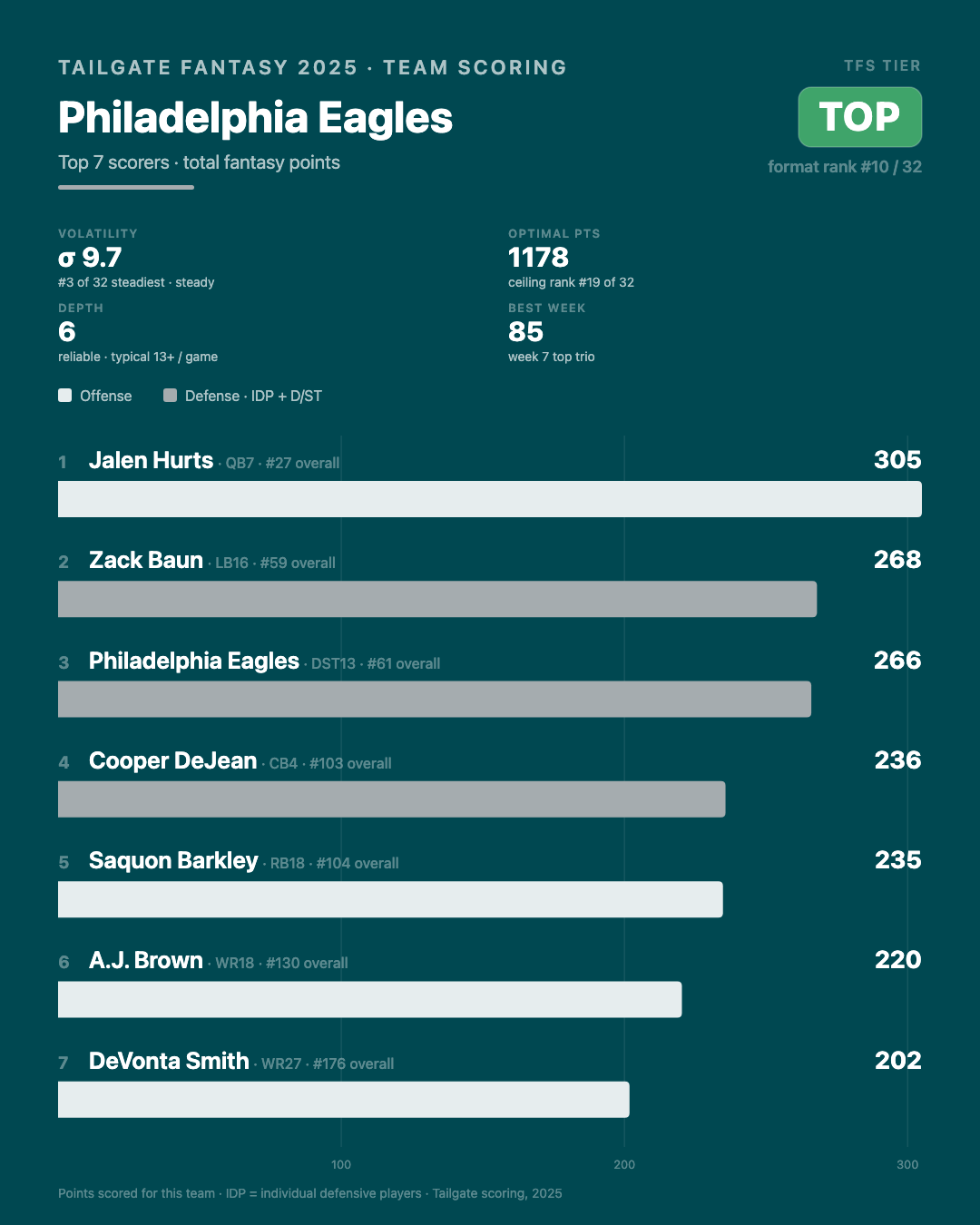
Saquon Barkley was the 5th-best fantasy scorer on his own team last year in our format.
The Eagles were the #19 offense by raw points. Here's the order that made me laugh:
1. Jalen Hurts (QB): 305 · QB7 (fine, makes sense)
2. Zack Baun (LB): 268 · LB16
3. Eagles D/ST: 266 · DST13
4. Cooper DeJean (CB): 236 · CB4
5. Saquon Barkley (RB): 235 · RB18, with A.J. Brown (WR19) and DeVonta Smith (WR28) behind him.
A back who was a first-round pick in every redraft league in America shows up as basically his own team's RB5-equivalent. It's not that Saquon was bad; he was #105 overall. It's that a loaded Philadelphia defense scored so hard that the household offensive names got buried.
But the sneaky-important part is how steady it all was. Zack Baun put up 4 boom weeks, zero busts, at sigma 4.6, one of the most metronomic scorers in the entire league. That team-wide consistency (sigma 9.7, and 6 players clearing a genuine starter's bar in a typical week) is why Philadelphia quietly climbs from ceiling #19 to a Top-tier format team (#10), exactly the safe-floor profile you want in a must-win H2H week.
Your printed draft cheat sheet is useless here, and honestly that's the fun of it. You look at who scores, not who's famous.
The 2026 read is the part worth sitting with. Philadelphia's offense actually faded last year: Hurts went from 22.0 a game to 16.2, Baun 19.2 to 14.2, DeVonta Smith 14.3 to 9.7. On most rosters that's a collapse. Here the D/ST went the other way, 12.2 up to 18.7, A.J. Brown climbed to 16.7, and the team score barely moved. That is the real argument for a Top-tier team in this format, and it isn't "they have good players." It's that when one half of the roster goes cold, the other half covers, so there is never a week where you open the app and have nothing worth starting. None of that is age-dependent or luck-dependent. Pencil them right back in here.
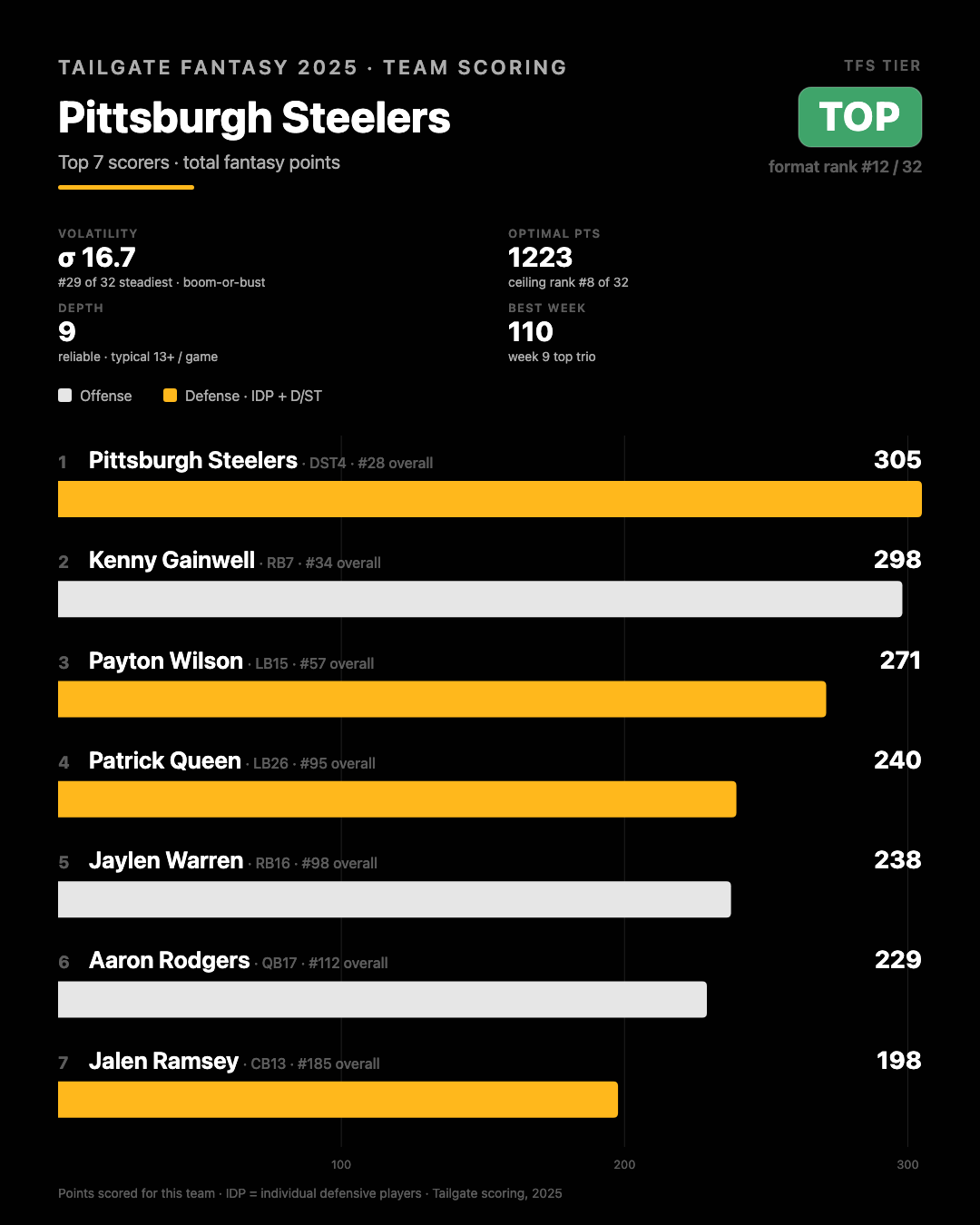
The Steelers were the deepest roster in football and one of the three most volatile. Both at once. That combination is why Pittsburgh has been so hard to place.
1. Steelers D/ST: 305 · DST4, #28 overall
2. Kenny Gainwell (RB): 298 · RB7
3. Payton Wilson (LB): 271 · LB15
4. Patrick Queen (LB): 240 · LB26
5. Jaylen Warren (RB): 238 · RB16
That's the fourth D/ST-led team of the countdown — Houston, Denver, the Chargers, now Pittsburgh — and the only one of the four where the defense leading isn't a sign of a thin offense. Nine Steelers cleared a starter's bar in a typical week, more than any other team in the league. Second place had eight. You could field a legal lineup out of this roster in any week of the season without touching a scrub.
And then there's the other number: sigma 16.7, third-highest in football. Here is what that looks like in practice, and it's my favorite two weeks on the whole board. Week 9: 110 points — D/ST, Payton Wilson, Joey Porter Jr., the highest trio week in this batch by seventeen points. Week 10: 49.5 points. Same roster. Next Sunday. That's the price of a defense-driven team, because when the defense doesn't get a takeaway, nothing rescues the week.
The 2026 read is a handoff from the defense to the run game. Kenny Gainwell went from 14.8 a game to 20.0, Jaylen Warren 14.1 to 15.4, Cameron Heyward 8.8 to 11.8. Falling: the D/ST from 21.5 to 14.8, Payton Wilson from 21.0 to 11.4, Rodgers 15.9 to 12.7. If the backfield keeps that late-season form, this becomes a much steadier team than the sigma suggests — depth like that plus a lower ceiling swing is a genuine top-five profile.
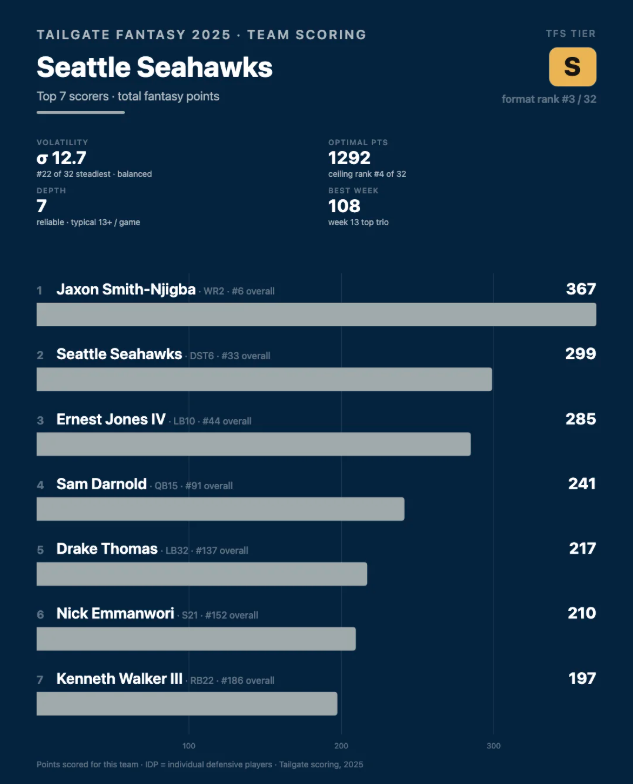
The Seahawks were an S-tier roster built on a receiver and a linebacker.
1. Jaxon Smith-Njigba (WR): 367 · WR2, #6 overall
2. Seahawks D/ST: 299 · DST6
3. Ernest Jones IV (LB): 285 · LB10
4. Sam Darnold (QB): 241 · QB15
5. Drake Thomas (LB): 217 · LB32
Ceiling #4, format rank #3 (S tier). JSN was the #2 receiver in football — 21.6 a game, 10 boom weeks against one bust — and behind him Seattle stacked the thing this format pays for: seven players clearing a starter's bar in a typical week, a top-6 defense, and a top-10 linebacker.
Week 13 is the single most Seattle week on the board: 107.6 points, and 94.6 of it was defense. Ernest Jones 49.6, the D/ST 45.0. The team that wins on defense in real life wins on defense in our scoring too, which is not a given — plenty of great real defenses score nothing here.
The 2026 read is a handoff, and this offseason made it literal. Sam Darnold fell hard, 17.2 a game to 11.6, and JSN cooled slightly (22.8 to 20.6). Everything else went up: Nick Emmanwori 12.2 to 16.5, DeMarcus Lawrence 8.6 to 13.1, Zach Charbonnet 9.4 to 13.0.
Kenneth Walker left in free agency, and Seattle spent the 32nd pick on Jadarian Price to replace him. So the question isn't whether the backfield lost anything — it's whether anything actually changed. The committee is what capped this backfield last season: Walker finished RB22, Charbonnet RB24, fifteen points apart. Charbonnet outscored him in 10 of their 17 shared weeks and closed better — 26.2 in week 17, 20.7 in week 18. Neither was ever the guy, because there was never a guy.
Here's the prize sitting on the table. Add the two together and last season's Seattle backfield is 379.8 points — RB2 in football, ahead of Jahmyr Gibbs. That's what one back gets if he wins the job outright. The catch is that you don't spend the 32nd pick on a runner you plan to back up, so the likeliest outcome is the same split with a rookie in Walker's half. Charbonnet has the incumbency and the better second half; Price has the draft capital. Watch September snaps before you spend anything on either.
A championship roster whose quarterback was its weakest starter, whose defense was accelerating into January, and whose backfield is one clean job-winner away from an RB1 is a scary thing to see on the schedule.
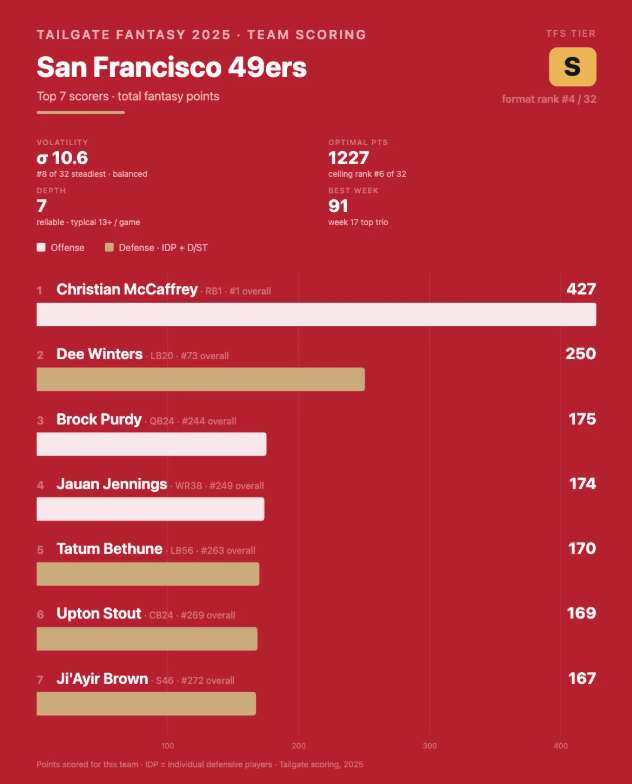
The San Francisco 49ers had the #1 overall scorer in football, by a mile — and the widest gap between a team's best player and its second-best on the entire board.
1. Christian McCaffrey (RB): 427 · RB1, #1 overall
2. Dee Winters (LB): 250 · LB20
3. Brock Purdy (QB): 175 · QB24 (9 games)
4. Jauan Jennings (WR): 174 · WR38
5. Tatum Bethune (LB): 170 · LB56
427 points. 25.1 a game. Twelve boom weeks and not a single bust in 17 games. CMC outscored the second-best player in football by more than 40 points and his own teammate by 177. 257 points separate San Francisco's #1 from its #5 — the most top-heavy roster in this format.
Now look at who the #2 and #5 are. Dee Winters and Tatum Bethune — two backup linebackers — finished second and fifth on this roster, and that is the whole 2025 49ers story in one line. Fred Warner, an All-Pro, played six games (18.6 a game, which would have been LB8 in football over a full season). Nick Bosa played three — he was averaging 18.0, second among every defensive lineman in the league, and put up 30.5 in week 1 before he was gone. Rookie Mykel Williams got nine. Their defensive coordinator's stated plan was, in as many words, “next man up,” and the scoring card is what next man up actually looks like: the replacements were the team's second- and fifth-best fantasy assets.
It wasn't only the defense. Brock Purdy played nine games. George Kittle played eleven — five missed early, then out again in week 17, right when he was your best swap on the board (24.5 in week 16). Half of San Francisco's best possible starting lineup was unavailable at any given moment.
Which should make them a trap, and it doesn't. The 49ers climb from ceiling #6 to format rank #4 — S tier — on floor. Sigma 10.6, the steadiest of any S-tier team, with seven players clearing a starter's bar in a typical week. That's the format working exactly as designed: you can't run CMC plus the same two guys every week, but on this roster the guys you rotate around him were reliably fine — and “fine” here meant whoever was next in line at linebacker. Their worst week of the year was 52 in a meaningless week 18; the week before it they put up 91.
Week 17 is the tell: 90.5 points, and CMC wasn't the leading scorer. Brock Purdy went for 36.9. That's the difference between a one-man team you fear and a one-man team you can actually win with.
The 2026 read is the best of any team in this batch, and it starts with health. Purdy went 16.2 a game to 20.4 once healthy, Kittle 8.4 to 18.6 (his 14.9 average was TE2 in football, behind only Trey McBride), Jauan Jennings 8.8 to 14.0, Ji'Ayir Brown 6.4 to 13.7 — a supporting cast that basically didn't exist in September and was genuinely good by December. CMC held steady at 23.8. Add a defense that gets Warner and Bosa back, and the two names San Francisco brought in at receiver: Dezshaun Stribling, the rookie taken 33rd overall in the 2026 draft, and Mike Evans, an All-Pro whose age is the only argument against him. If that back half is the real team and the injury luck evens out, San Francisco is the #1 roster in the format next season.
An S-tier season with an All-Pro linebacker for six games and an All-Pro edge for three. What does this roster look like healthy?
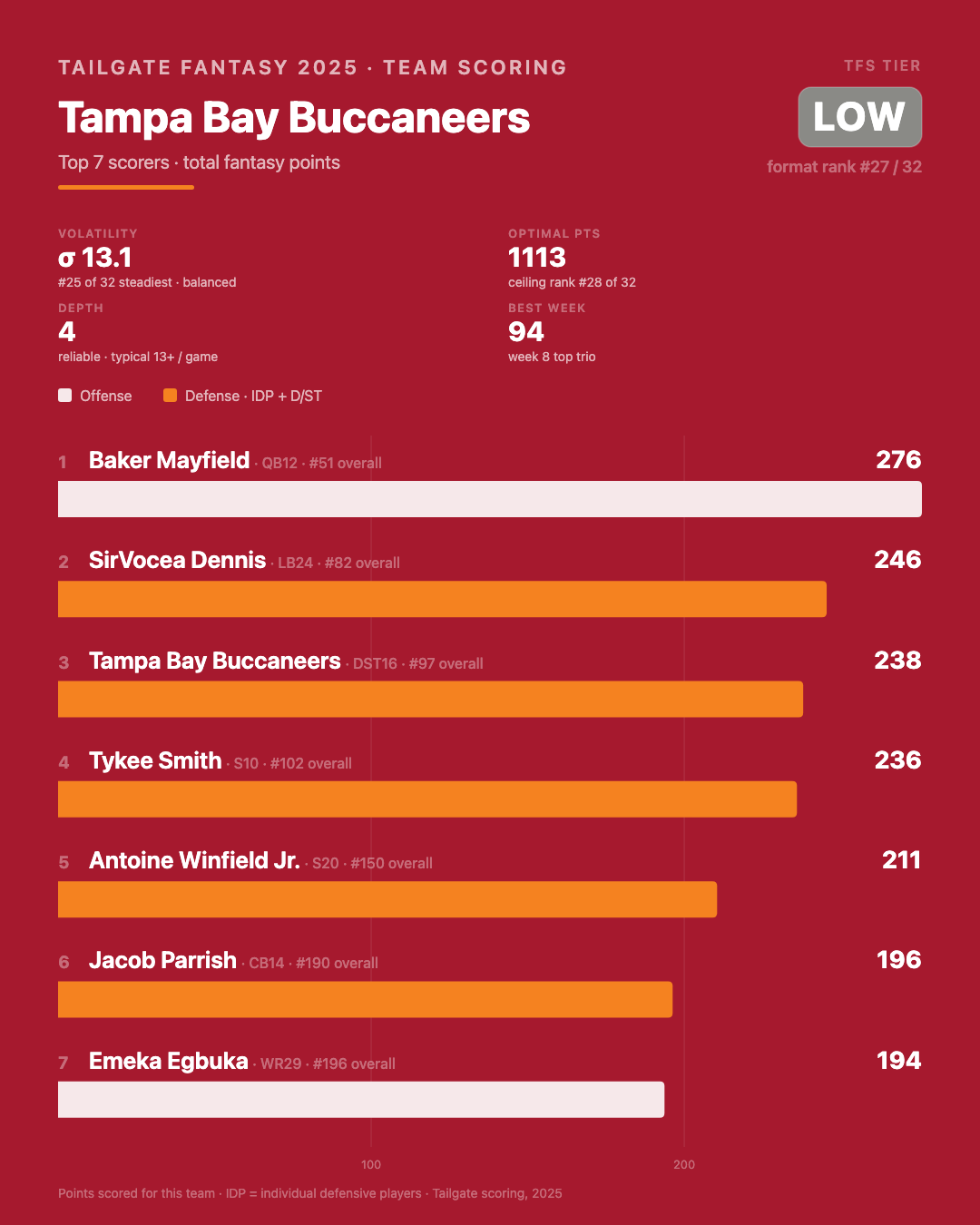
The Bucs had exactly one household name last season. He was only the #51 scorer.
Tampa was the #28 offense (Low tier). Baker Mayfield led them at 276, and this is the quiet lesson: #51 overall sounds unspectacular, but that's still QB12. After him it's a parade of names casual fans probably don't know:
1. Baker Mayfield (QB): 276 · QB12
2. SirVocea Dennis (LB): 246 · LB24
3. Buccaneers D/ST: 238 · DST16
4. Tykee Smith (S): 236 · S10
5. Antoine Winfield Jr. (S): 210 · S20
Tampa was only whole for about five weeks. Chris Godwin didn't suit up until Week 4, Mike Evans went down after Week 3 and missed 9 of 17, and Bucky Irving vanished from Week 6 through Week 12. Before the room emptied out this was a real offense: Mayfield averaged 21.1 a game through Week 5, top-3 QB pace, with Irving at 18.0 and a rookie receiver at 20.1 next to him.
Then you get to watch it come apart and go back together. Weeks 6 through 12, with everyone hurt at once, Mayfield dropped to 13.4 a game with a 4.1 and a 5.5 in the middle of it. Then the weapons came back: Evans for 13.9 a game down the stretch, Godwin for 11.1, Irving for 11.1. Baker's average only climbed to 15.0, but the shape changed completely, because across his last six games his worst week was 11.1. No more disasters. That's what a functional supporting cast actually buys a quarterback in this format. Not a higher ceiling, a floor.
The exception, and the honest asterisk on his rookie year, is Emeka Egbuka: 20.1 a game through Week 5, 5.6 from Week 13 on, and never once cracking 11 points after Week 10. Some of that is the rookie wall, some of it is that the targets he'd been eating by default went back to their owners. His 193.7 (WR30) is the average of two completely different players.
Once it’s all over three of their top five were defenders, two of them top-20 safeties, and there's not a single obvious must-start on the roster. That's the double edge of a team like this: the depth means no single spot sinks you, but nothing wins you a week outright either (sigma 13.1, and the swings come from the defense's boom weeks). When your reliable offense gets shredded you'd have to actually read the box scores to know who to play, which is either a chore or the entire appeal, depending on your personality.
Which is why Tampa is the Low-tier team most likely to rocket up this list next year. Godwin gets an offseason instead of rehabbing his way into Week 12. Egbuka gets a real WR2 across from him, which is the version of the roster that produced the 16-a-game rookie, not the one that got bracketed into oblivion. And Baker Mayfield is a dog: he put up top-3 QB numbers with a full receiving corps and still willed his way to QB12 throwing to nobody for three straight months. Give him weapons for a full season and the #28 offense doesn't stay #28.
The Vita Vea situation is the part everyone's reading as a defensive story, and in fantasy it isn't. Vea scored 95.5 with ten bust weeks; you would never start him. He's just the reason three of the five guys above him are startable at all. Two top-20 safeties and a DST16 is what a roster looks like when a nose tackle is absorbing double teams on every snap, and that's not a stat that shows up in his line, it shows up in theirs. So the trade request isn't a question about losing a player from Tampa's top five, it's a question about whether the rest of the top five holds up without him. Sort that out and you've got a Low-tier team with a legitimate Top-tier ceiling.
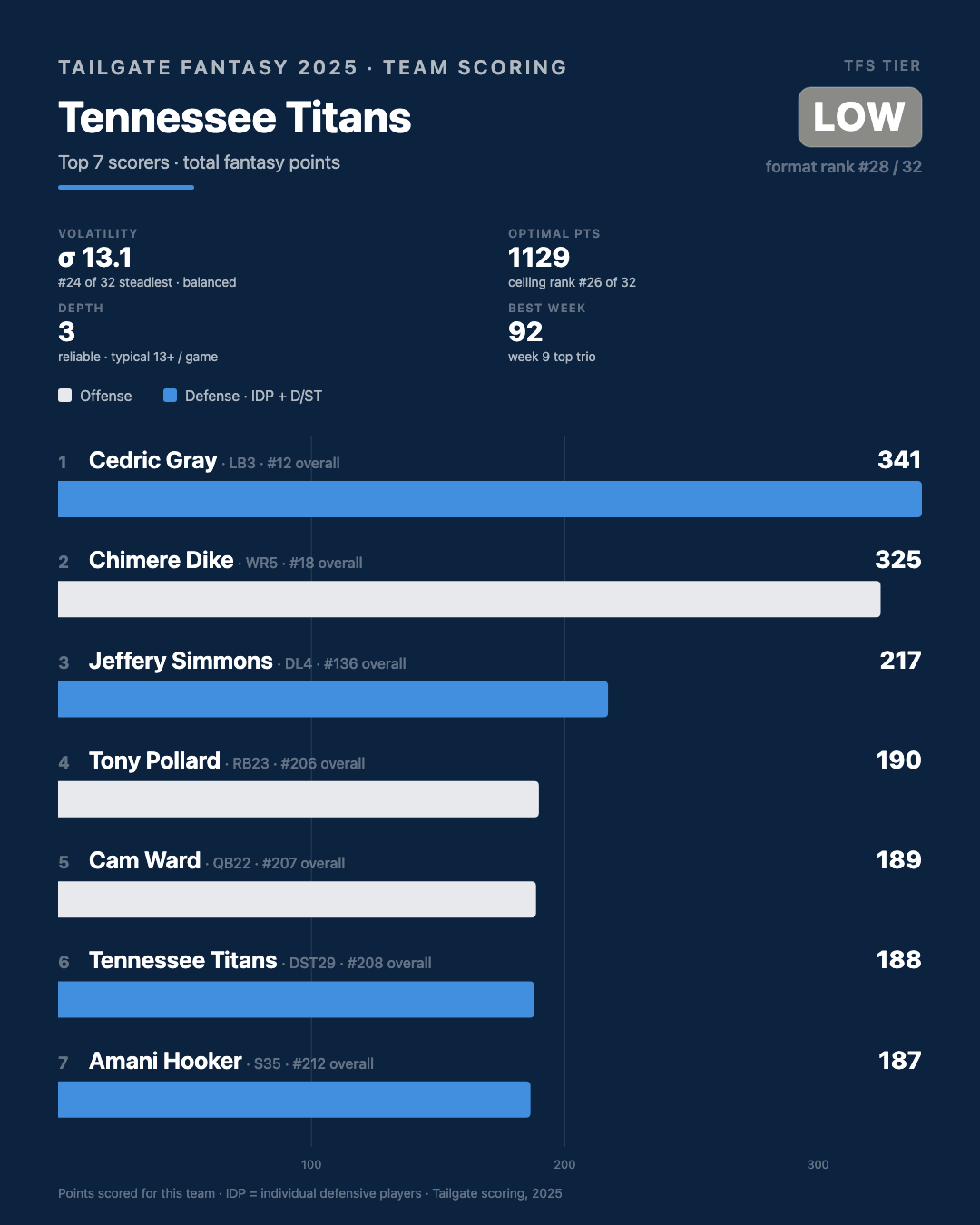
The Tennessee Titans are the best argument on the whole board that two stars are not a roster.
The Titans had two top-20 players in all of football. Cedric Gray was the #3 linebacker and #12 overall. Chimere Dike was WR5 and #18 overall. Nobody outside Nashville had either one on their radar. On most boards that's a playoff team.
1. Cedric Gray (LB): 341 · LB3, #12 overall
2. Chimere Dike (WR): 325 · WR5, #18 overall
3. Jeffery Simmons (DL): 217 · DL4
4. Tony Pollard (RB): 190 · RB23
5. Cam Ward (QB): 189 · QB22
Look at the drop. Gray and Dike are separated by 16 points; then there's a 108-point cliff to the third-best player on the team. Tennessee finished #28 of 32 in format rank despite two genuine stars, and the reason is the rule: you have to swap two of your three starters every week. Only three Titans cleared a real starter's bar in a typical week — tied for the thinnest roster in football outside Carolina and Las Vegas. So the week you sit Gray, you're not sitting him for another good player. You're sitting him for Cody Barton.
That's also why they were so swingy (sigma 13.1, best week 92, worst week 41). When your two stars are the whole team, their off weeks are the team's off weeks.
The 2026 read is genuinely encouraging, though, and it isn't about Gray or Dike. It's Cam Ward, who went from 8.1 a game in the first half to 14.5 in the second — a rookie quarterback who essentially became a different player after the bye. Tony Pollard climbed too (10.1 to 12.3). Tennessee doesn't need another star; they have two. They need a fourth and fifth option so the forced weekly swap stops being a punishment, and a second-year quarterback trending the way Ward was is exactly how a depth-3 roster becomes a depth-5 roster.
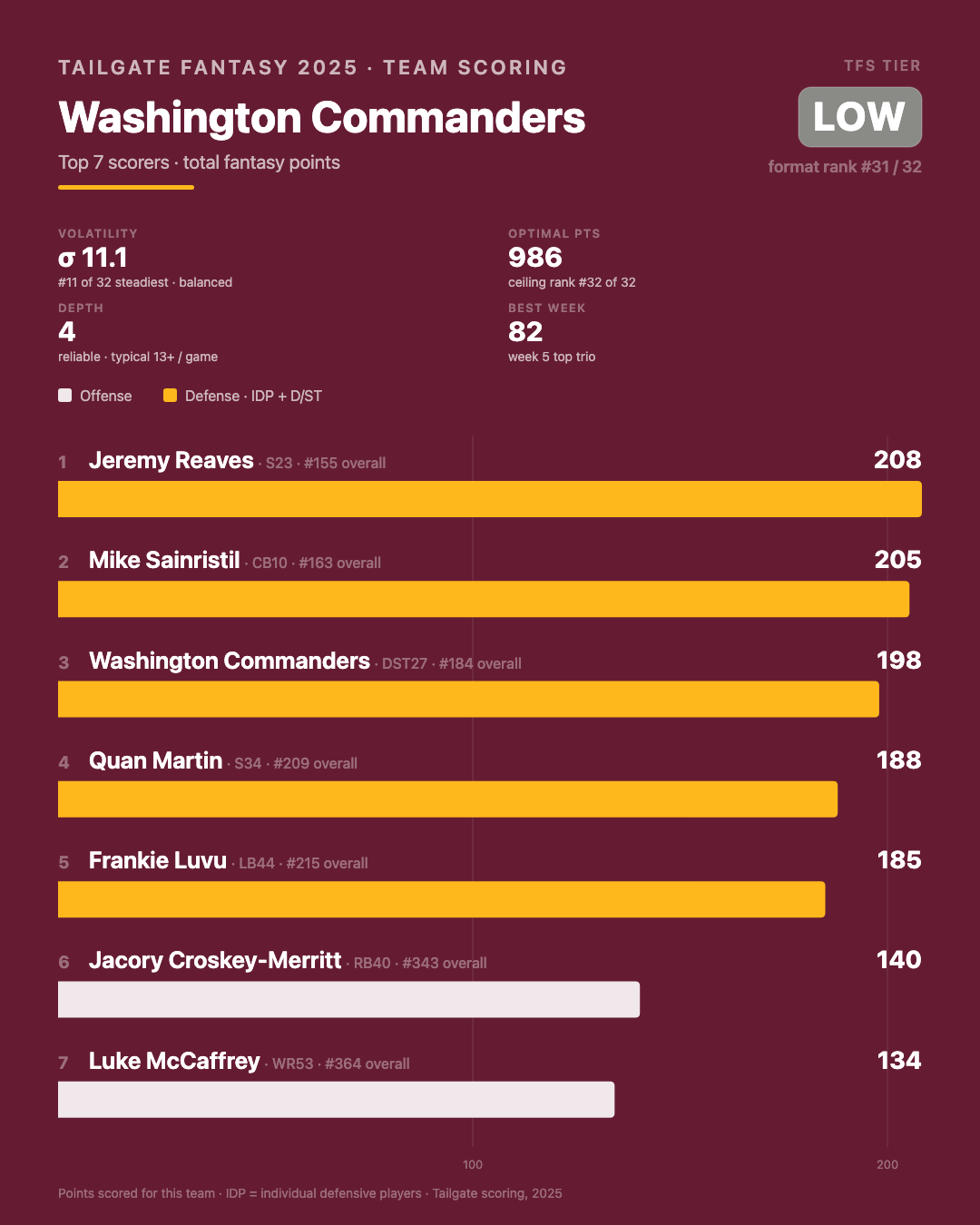
The Commanders had the lowest-ceiling offense in football, and every one of its top 5 scorers played defense.
Washington had the single lowest ceiling in the entire league, optimal trio #32 of 32. That's how a genuinely steady team still finishes near the very bottom at #31. It isn't really a depth problem; four players cleared a real starter's bar in a typical week. It's that the best trio they could ever put on the field was the worst in football, and there's a hard cap on a roster like that. What's left is a pure defense-first roster.
Their entire top five:
1. Jeremy Reaves (S): 208 · S23
2. Mike Sainristil (CB): 205 · CB10
3. Washington Commanders D/ST: 198 · DST27
4. Quan Martin (S): 188 · S34
5. Frankie Luvu (LB): 185 · LB44
Not one offensive skill player in the group; five defenders and their D/ST. When Jayden Daniels went out for the season in early Nov last year so did the whole offense. When healthy he was fine at 16.7/gm, but his absence left the fantasy value entirely on the defensive side of the ball. With Daniels coming back, fans will hope he'll bring that same magic to the 2026 season.
Here's the parity angle, and it's one of the strongest on the whole board. This was the lowest-ceiling team in football, and it still wasn't a dead roster. The handful at the top barely wobbled: a top-5 spread of just 23 points, sigma 11.1, among the league's steadiest, and one of them was a genuine top-10 corner in Sainristil. The ceiling is what caps them at #31, but even the team with the lowest ceiling in the league gave you a rock-steady building block nobody else was drafting.
There are no dead rosters, only dead lineups, even when your generational QB is out for over half the season.